38
NOTE: DIAGRAMS & ILLUSTRATIONS ARE NOT TO SCALE.
Test gauge connections are provided on the
front of the gas control valve, identified IN for
the inlet and OUT for the manifold side (see
Figure 60 on Page 39). The control valves
have a 3/8" (10 mm) NPT thread inlet and
outlet side of the valve.
Propane tanks are at pressures that will cause
damage to valve components. Verify that the
tanks have step down regulators to reduce the
pressure to safe levels.
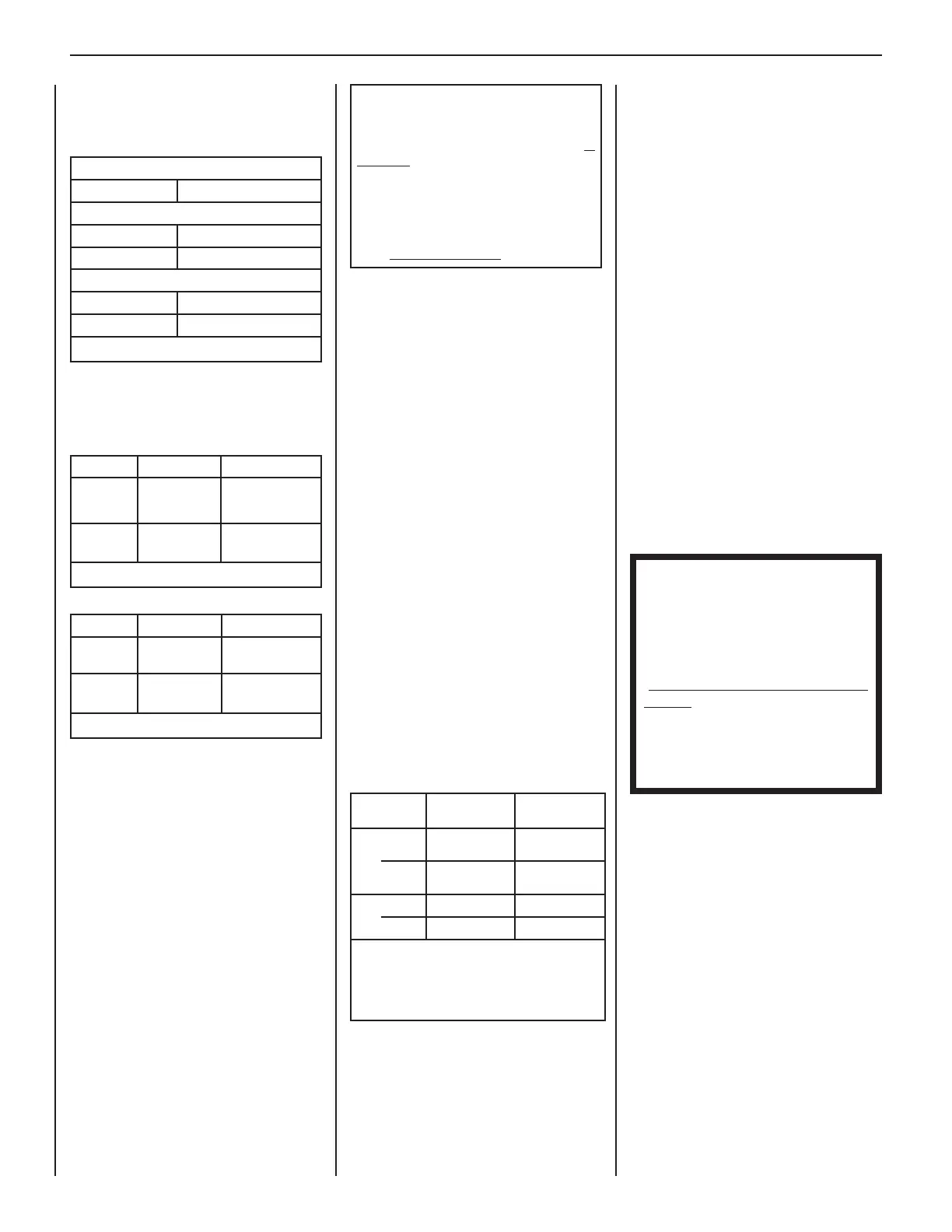
BTU INPUT
The BTU Input for these appliances are shown
in Table 12.
Model No. Input (BTU/Hr)
Natural Gas
40 in. 32,000–50,000
45 in. 40,000-57,000
Propane Gas
40 in. 32,000–50,000
45 in. 43,000–56,000
Table 1: Input (BTU/HR)
Model
Natural Gas
drill size (in.)
Propane
drill size (in.)
Traditional
40 in.
0.1405" (#28)*
• H2286
0.086" (#44)*
• H2287
45 in.
0.150" (#25)*
• H8808
0.086" (#44)*
• H2287
Contemp
40 in. 0.0700" (#50)* 0.0700" (#50)*
45 in. 0.0700" (#50)* 0.0700" (#50)*
* Standard size installed at factory
• Part /Cat. Number
The appliance and its appliance main gas
valve must be disconnected from the gas
supply piping system during any pressure
testing of that system at test pressures in
excess of 1/2 psi (3.5 kPa).
The appliance must be isolated from the gas
supply piping system by closing its equipment
shutoff valve during any pressure testing of
the gas supply piping system at test pres-
sures equal to or less than 1/2 psi (3.5 kPa).
Orifice Sizes— Sea Level to High Altitude
(All Models)
These appliances are tested and approved for
installation at elevations of 0-4500 feet (0-1372
meters) above sea level using the standard burner
orifice sizes (marked with an "*" in Table 14 ).
For elevations above 4500 feet, contact your
gas supplier or qualified service technician.
Deration—At higher elevations, the amount
of BTU fuel value delivered must be reduced
by either using gas that has been derated by
the gas company or by changing the burner
orifice to a smaller size as regulated by the
local authorities having jurisdiction and by the
(USA) National Fuel Gas Code NFPA 54/ANSI
Z223.1—latest edition or, in Canada, the CAN/
CGA-B149.1 codes—latest edition.
Install the appliance according to the regulations
of the local authorities having jurisdiction and,
in the USA, the National Fuel Gas Code NFPA
54 / ANSI Z223.1—latest edition or, in Canada,
the CAN/CGA-B149.1—latest edition.
Flame breadth, height and width will diminish
4% for every 1,000 feet of altitude.
NOTICE: A white film may develop
on the glass enclosure panel during
the first few fires as part of the burn-in
process.
The first few times you use the
fireplace, clean the glass after each use
(AFTER THE GLASS HAS COMPLETELY
COOLED); otherwise, the white film
will bake onto the glass and become
difficult to remove.
See glass cleaning instructions on
Page 41.
In Canada—CAN/CGA-2.17-M91 (R2009)
(high altitude):
THE CONVERSION SHALL BE CARRIED
OUT BY A MANUFACTURER’S AUTHO-
RIZED REPRESENTATIVE, IN ACCOR-
DANCE WITH THE REQUIREMENTS OF
THE MANUFACTURER, PROVINCIAL OR
TERRITORIAL AUTHORITIES HAVING
JURISDICTION AND IN ACCORDANCE
WITH THE REQUIREMENTS OF THE
CAN/CGA-B149.1 OR CAN/CGA-B149.2
INSTALLATION CODES.
Burn-in Period
During the first few fires of this appliance there
will be some odor due to the curing of the
paint and burning off of lubricants used in the
manufacturing process. Depending on your
use, the burn-in period may take a few hours
or a few days.
KEEP YOUR HOUSE WELL VENTILATED
DURING THE CURING PROCESS. THE ODOR
AND HAZE EMITTED DURING THE CURING
PROCESS CAN BE QUITE NOTICEABLE AND
MAY SET OFF A SMOKE DETECTOR.
Table 12: Input (BTU/HR
Table 13: Inlet Gas Supply Pressure
Table 14: Manifold Gas Supply Pressure
Table 15: Burner Orifice Sizes,
Elevation 0–4500 ft ( 0–1372 m)
INNOVATIVE HEARTH PRODUCTS • DIRECT-VENT GAS FIREPLACES (DRT6300/DRC6300) • CARE AND OPERATION INSTRUCTIONS
Fuel # Minimum Maximum
Natural Gas
5.5" WC
(1.37 kPa)
10.5" WC
(2.61 kPa)
Propane
11.0" WC
(2.74 kPa)
13.0" WC
(3.23 kPa)
GAS PRESSURE
Table 2 and Table 13 show the appliances'
gas pressure requirements.
Fuel # Low High
Natural Gas
1.6" WC
(.4 kPa)
3.5" WC
(.87 kPa)
Propane
6.3" WC
(1.57 kPa)
10.0" WC
(2.49 kPa)



 To Next Page