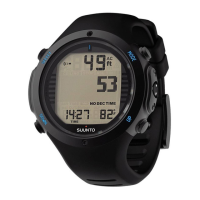
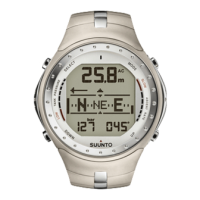
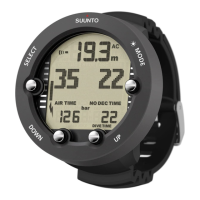
In Air / Nitrox mode, you will see the following information in compass view:
In the switch window, you see the heading in numeric format.
In the Compass menu you can turn the bearing on or o, calibrate the compass, and set
declination.
3.7.1. Calibrating compass
When you first start using Suunto D5, and after each charging, the compass needs to be
calibrated and it is required to do so to activate it. Suunto D5 displays the calibration icon
when you enter the compass view.
During the calibration process, the compass adjusts itself to the surrounding magnetic field.
Because of changes in the surrounding magnetic field, it is recommended to re-calibrate the
compass before each dive.
To manually start calibration:
1. Take o your Suunto D5.
2. Keep the middle button pressed to enter the menu.
3. Browse to General / Compass.
4. Press the middle button to enter Compass.
5. Scroll up or down to select Calibrate.
6. Start calibrating the device by trying to move it around the xyz axels of the coordinate
system (like you were drawing a small circle) so that the magnetic
field is as stable as
possible during the calibration. To achieve this, try to keep Suunto D5 in the same location
and do not move it around using large movements.
7. Repeat the rotation as long as the compass calibration is successful.
8. A sound indicates when the calibration succeeded, and the screen goes back to Compass
menu.
NOTE: If the calibration fails several times in a row, you may be in an area with strong
sources of magnetism, such as large metal objects. Move to another location and try to
calibrate the compass again.
3.7.2. Setting declination
You should always adjust your compass declination for the area where you are diving to get
accurate heading readings. Check the local declination from a trusted source and set the
value in Suunto D5.
Suunto D5
17


 To Next Page