Equipment details
94
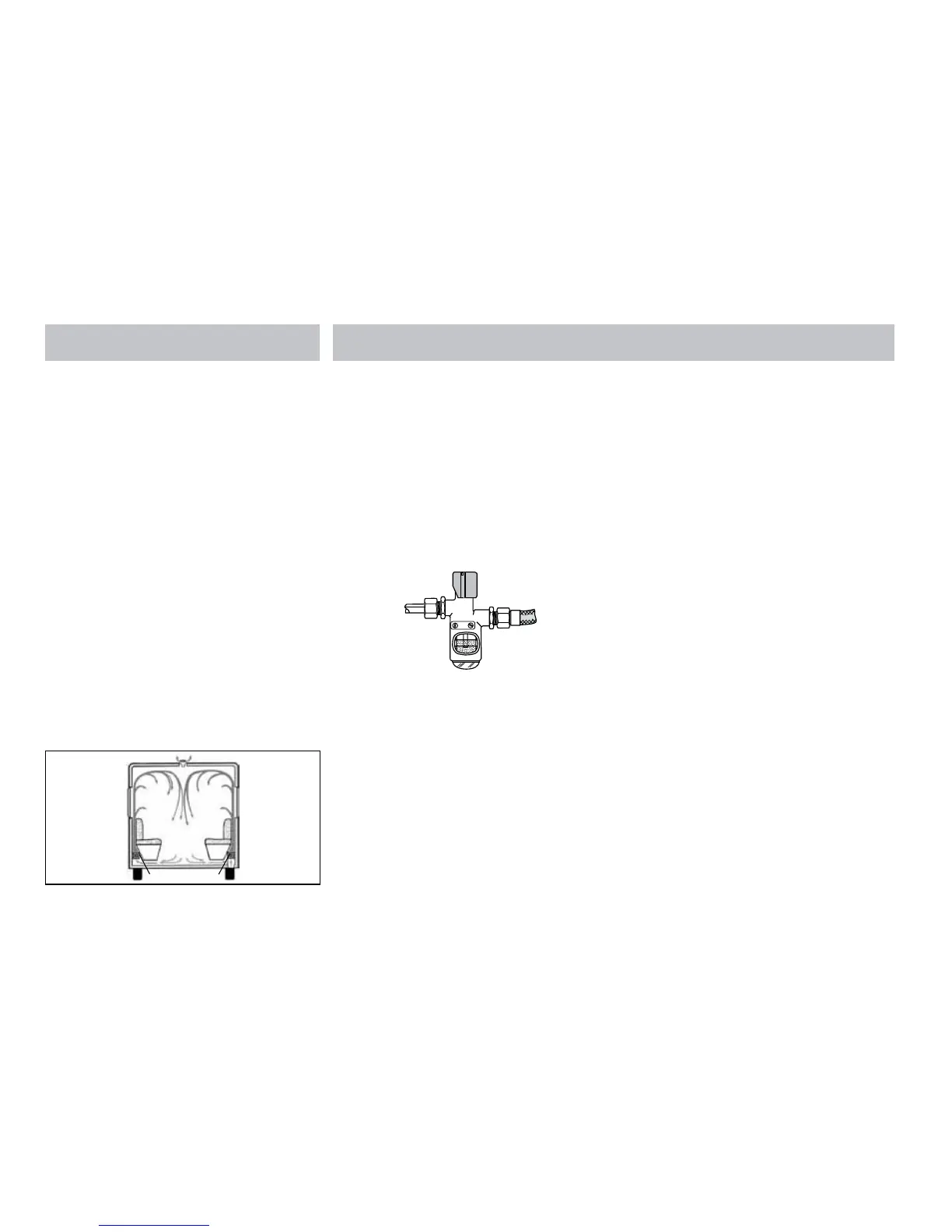
AIR CIRCULATION
In order to achieve the best possible result from
the principle of convected heat, it is important
to allow air to circulate freely under bunks, and
behind backrests and wall-mounted cabinets.
If the vehicle has a fitted carpet, ensure that the
carpet does not obstruct the air supply to the
radiators.
It is just as important that cushions or blankets
do not interrupt the flow of air behind backrests
and wall cabinets.
MAINTAINING THE HEATING
SYSTEM
WINTERCAMPING
While camping during the winter, ensure that
the flue is kept clear of snow and ice, since the
inlet air to the LPG boiler enters through the
flue. Do not start the LPG boiler until the flue
is completely free of snow. A flue extension
(part no. 3000 320) for fitting on the roof is
recommended for winter camping.
Air stream
Convectors
THE LPG SYSTEM
The LPG system should be checked regularly
by a professional, who will ensure that there are
no leaks from connections or hoses.
LPG hoses should be changed according to
national regulations, maximum of five years.
Check the date stamp on the hose. Hose has a
propensity to dry out and crack.
To increase safety, we recommend fitting
an Alde leak gauge, type 4071, as close as
possible to the pressure reduction valve.
THE HEATING SYSTEM
Regularly check the heating system’s fluid level
in the expansion tank. The level should be
about 1cm above the minimum indicator in a
cold tank. The heating system should be filled
with a mixture of water and glycol.
For preference, use high quality readymixed
glycol (with inhibitor) intended for use in
aluminium heating systems.
If using concentrated glycol, the mixture should
consist of 60% water and 40% glycol. If the
heating system will be exposed to temperatures
below -25°C, the glycol content must be
increased, but not to more than 50%. Any
vessels used for the liquid must be spotlessly
clean, and the pipes in the heating system must
be free of contamination. This will prevent the
growth of bacteria in the system.
The glycol mixture should be changed every
second year, since its ability to protect against
corrosion, for example, will deteriorate. The
glycol content should be checked before
topping up with new liquid. This will ensure that
the concentration of glycol in the mixture is not
too high.
If the fluid level in the expansion tank falls for
reasons other than evaporation, please check
all joints, drain cocks and bleeder screws to
ensure that they are not leaking. If the glycol-
water mixture leaks out, rinse with water and
wipe up.
Never allow the heating system to stand empty
of glycol.
FILLING THE SYSTEM WITH GLYCOL FLUID
NB! Any vessels used to carry the fluid must
be spotlessly clean and the pipes in the system
must be free of contamination. This will prevent
the growth of bacteria in the system.
The system is filled through the expansion tank,
either manually or using the Alde filling pump






 To Next Page