Equipment details
95
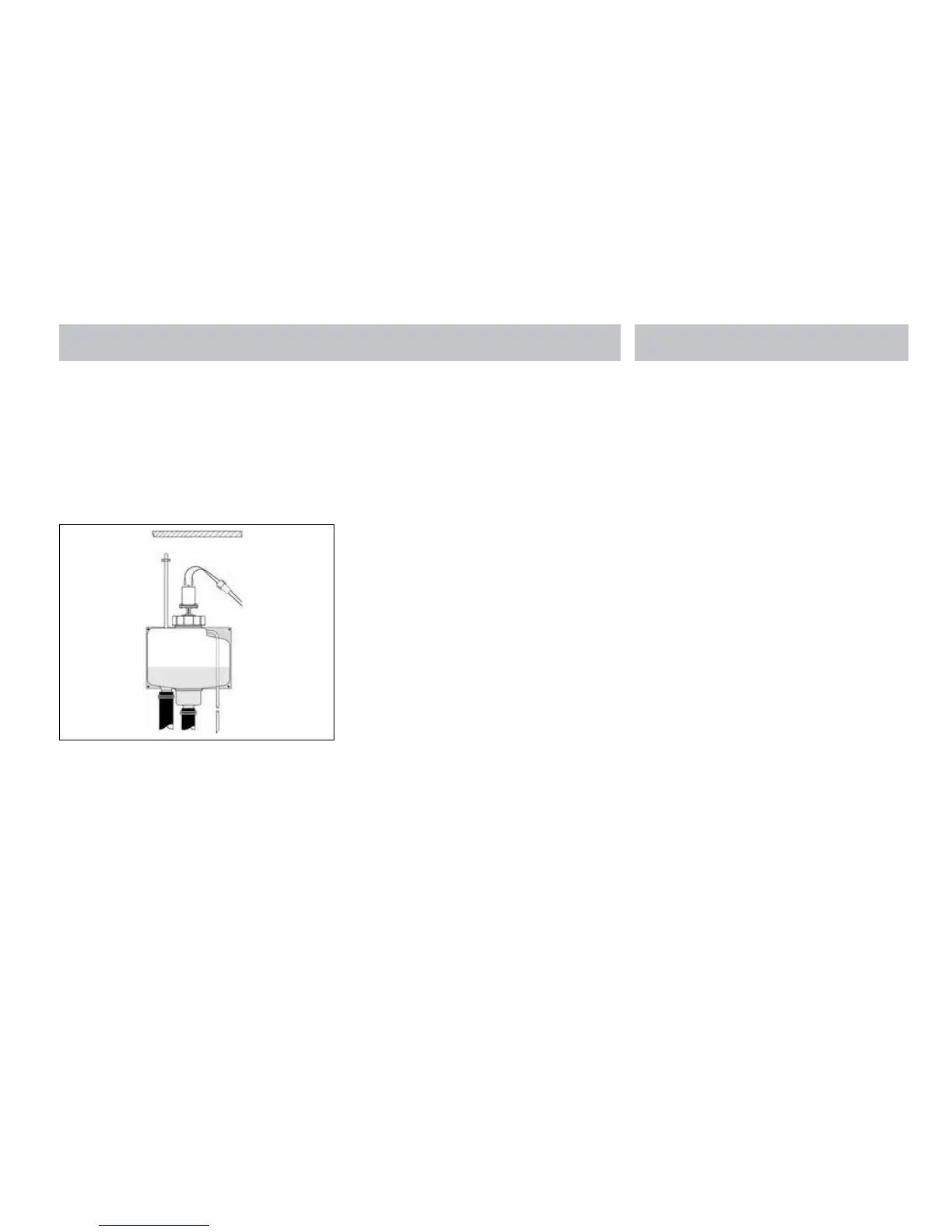
which both tops up and bleeds the system. For
manual filling, unfasten the circulation pump nut
(R) and lift the pump (S) out of the tank. Slowly
pour the glycol mixture into the tank. Bleed the
system.
Top up with more liquid if the level has fallen
after bleeding. Bleed a newlyfilled system
regularly during the first days the heating
system is in operation.
BLEEDING THE SYSTEM
Depending on how the pipes have been fitted,
air pockets may form when the system is filled
with glycol fluid.
A sign that there is air trapped in the system
is that the heat released into the pipes only
extends a metre or so from the boiler even
though the circulation pump is operating.
In newly-filled systems, small air bubbles
can form in the expansion tank, creating a
murmuring sound. If the circulation pump is
stopped for a few seconds, the bubbles will
disappear.
Bleeding:
If a bleeder screw is fitted to the outgoing pipe,
open this bleeder screw and leave it open until
it starts to discharge water.
If the boiler is fitted with an automatic bleeder,
there is no need to bleed it manually. Start the
LPG boiler. The circulation pump should be
switched off.
Open the remaining bleeder screws in the
system (please refer to the instruction manual
of the vehicle for their locations). Leave the
bleeder screws open until they start discharging
fluid, and then close them. Start the circulation
pump and let it run for a while. Check that the
pipes and radiators around the vehicle are
heating up.
If they still fail to heat up, try the following:
Single-axle caravan: Stop the circulation
pump. Lower the front of the caravan as far
as possible. Leave it in this position for a few
minutes to allow the air to travel upwards in
the system. Open the bleeder screw at the
highest point. Leave it open until it discharges
glycol fluid. Raise the front of the caravan as
far as possible and repeat the procedure in this
position.
Then position the caravan horizontally and start
the circulation pump. Check that the pipes and
radiators around the vehicle are heating up.
Twin-axle caravan:
The easiest way to bleed the heating system is
to place the vehicle on a sloping surface or to
raise one end of the vehicle using a jack. Bleed
the system as described above.
ABOUT LPG
THE PROPERTIES OF LPG
LPG is a petroleum product, formally known
as “liquid petroleum gas”. It is mainly made
up of propane and butane gas. The advantage
of propane is that it remains gaseous at
temperatures as low as -40°C, while butane
loses effectiveness at +10°C. For this reason,
propane is used in colder countries.
The cylinders contain LPG both in liquid and
gaseous form. When the cylinders are filled,
the pressure turns the gas into liquid. When the
cylinder valve is opened, the LPG becomes a
gas again. The risk involved in using LPG is that
any leaking gas may ignite and explode. Since
LPG is heavier than air, any leaking gas will
collect at the lowest point.
LPG contains no toxic substances, but
breathing in concentrated gas may have a



 To Next Page