11.2.3. Set the Output ON or OFF
This command turns the power supply output on or off.
The output on command may not work as expected. The latching power supply faults, including AC fault,
over-temperature, J1-Enable and J1-Shut Off, will prevent turning the output on until the fault clears. For
non-latching faults, including over-voltage and current fold-back, turning the output on will clear the fault.
Syntax:
OUTPut:STATe <0|1|OFF|ON>
Parameter: 0 or OFF will set the power supply output to OFF
1 or ON will set the power supply output to ON, if it is able to
Example:
OUTP:STAT 1 (or OUTP:STAT ON)
Query:
OUTP:STAT? will return ON in the example, otherwise OFF
Errors: SYSTEM:ERROR? may return errors including:
+307, “On during fault”
11.3. Measuring the Output
11.3.1. Measure the Output Voltage
This query returns the measured voltage at the output terminals (or remote sense point)
Syntax:
MEASure:VOLTage?
Example: M E AS:VOLT? may return 02.006
Response: Volts as a 5-digit number, which is one decimal place more than the power
supply’s front panel voltmeter
11.3.2. Measure the Output Current
This query returns the measured current at the output terminals.
Syntax:
MEASure:CURRent?
Example: M EAS:CURR? may return 009.48
Response: Amps as a 5-digit number, which is one decimal place more than the
power supply’s front panel ammeter
11.4. Operating Modes
11.4.1. Read CV or CC Modes
The power supply may operate in the constant-voltage or constant-current mode. The mode is selected
automatically depending on the voltage limit, current limit and load. settings. The mode is not defined
when the supply’s output is off
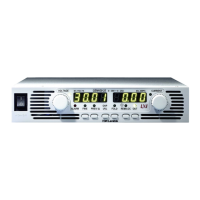
The CV or CC mode is shown on the supply front panel LEDs above the encoders.
Syntax:
SOURce:MODe?
Example: SOUR:MOD?
Responses: CV when in constant-voltage mode
CC when in constant-current mode
OFF when the output is off
39



 To Next Page