EasyManua.ls Logo

Teac A-3300S - Owners Care and Maintenance; Cleaning Procedures

Teac A-3300S
30 pages
Print Icon
To Next Page IconTo Next Page
To Previous Page IconTo Previous Page
Loading...
Owner's
care
of
the
TEAC
3300S
Cleaning
of
the
heads.
The
single
most
important
point
in
tape
deck
maintenance
is
frequent
and
proper
cleaning
of
the
heads.
The
heads
should
always
be
cleaned
before
making
important
record¬
ings
and
at
least
once
for
every
8
hours
of
use
(record
or
playback).
Dirty
heads
will
cause
a
reduction
in
high
fre¬
quency
response,
irregular
head
wear,
drop
out
and
in
ex¬
treme
cases
may
cause
the
deck
not
to
record
at
all.
The
small
amount
of
time
and
effort
required
will
be
more
than
compensated
for
by
the
higher
quality
of
recording
and
re¬
production
available
if
these
procedures
are
followed.
Commonly
used
cleaning
fluids
are
chJorothane,
absolute
(anhydrous)
alcohol
and
TEAC
Head
Cleaner
(Fluid
“A"
in
the
TZ-261
kit).
Chlorothane
is
non-flammable
and
has
excellent
cleaning
properties.
Alcohol
is
harmless
but
is
combustible
and
its
cleaning
properties
are
lower.
TEAC
Head
Cleaning
Fluid
is
non-toxic,
non-combustible
and
has
excellent
cleaning
properties
and
its
use
is
recommended.
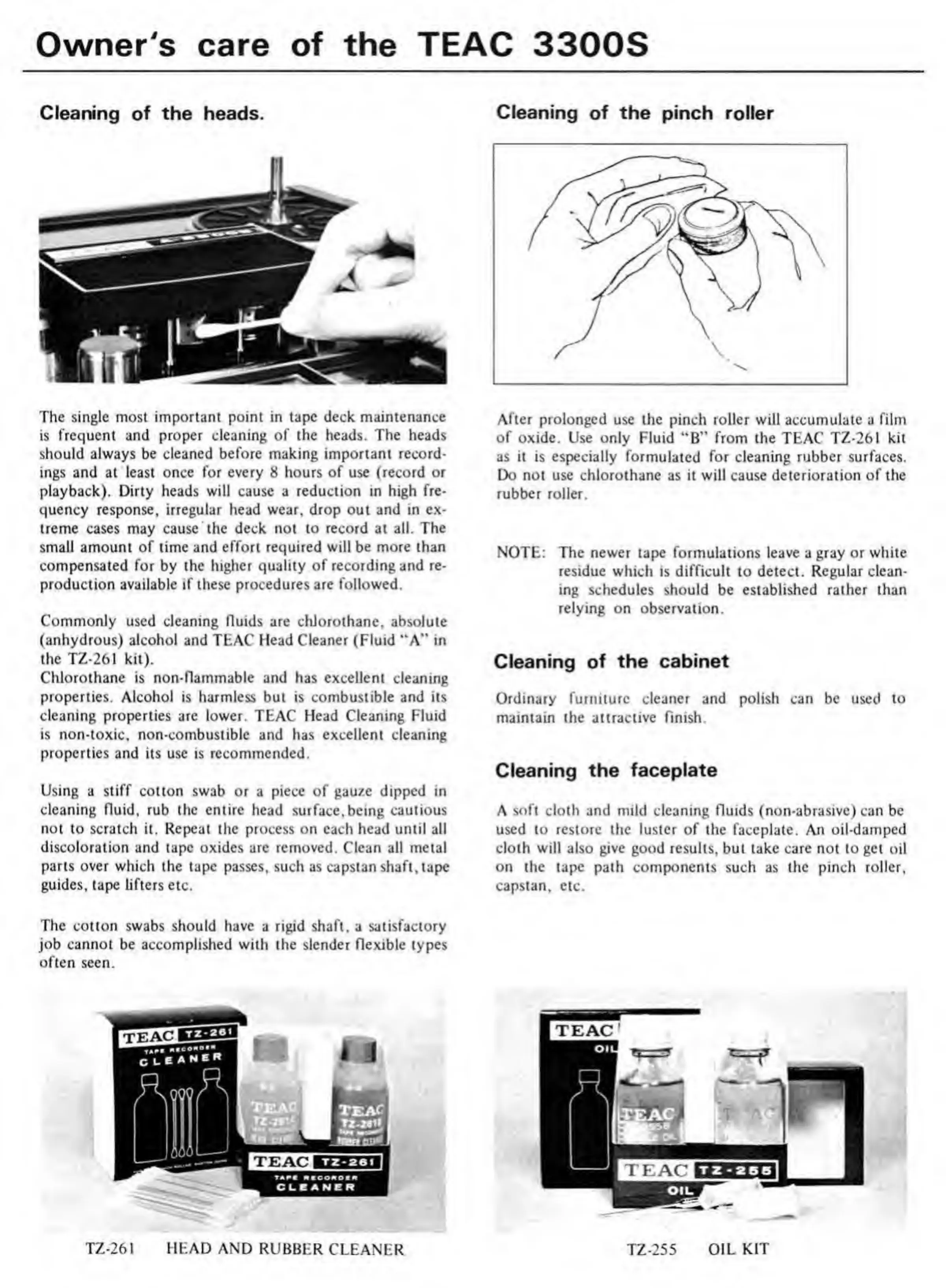
Using
a
stiff
cotton
swab
or
a
piece
of
gauze
dipped
in
cleaning
fluid,
rub
the
entire
head
surface,being
cautious
not
to
scratch
it.
Repeat
the
process
on
each
head
until
all
discoloration
and
tape
oxides
are
removed.
Clean
all
metal
parts
over
which
the
tape
passes,
such
as
capstan
shaft,
tape
guides,
tape
lifters
etc.
The
cotton
swabs
should
have
a
rigid
shaft,
a
satisfactory
job
cannot
be
accomplished
with
the
slender
flexible
types
often
seen.
TZ-261
HEAD
AND
RUBBER
CLEANER
Cleaning
of
the
pinch
roller
After
prolonged
use
the
pinch
roller
will
accumulate
a
film
of
oxide.
Use
only
Fluid
“B"
from
the
TEAC
TZ-261
kit
as
it
is
especially
formulated
for
cleaning
rubber
surfaces.
Do
not
use
chlorothane
as
it
will
cause
deterioration
of
the
rubber
roller.
NOTE:
The
newer
tape
formulations
leave
a
gray
or
white
residue
which
is
difficult
to
detect.
Regular
clean¬
ing
schedules
should
be
established
rather
than
relying
on
observation.
Cleaning
of
the
cabinet
Ordinary
furniture
cleaner
and
polish
can
be
used
to
maintain
the
attractive
finish.
Cleaning
the
faceplate
A
soft
cloth
and
mild
cleaning
fluids
(non-abrasive)
can
be
used
to
restore
the
luster
of
the
faceplate.
An
oil-damped
cloth
will
also
give
good
results,
but
take
care
not
to
get
oil
on
the
tape
path
components
such
as
the
pinch
roller,
capstan,
etc.
TZ-255
OIL
KIT

Related product manuals