6 Using the product
41
If the measurement values fluctuate widely, it is advisable to damp
the measurement values. Damping is activated in the probe menu
see Probe menu, page 25.
6.6.9. Determination of volume flow using differential
pressure and k factor
Setting available as of firmware version 1.10.
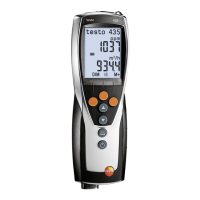
The testo 480 can determine the volume flow by measuring the
reference resistance and entering the so-called k factor. This is a
really simple process, especially for tasks involving setting air
outlets, because the measuring instrument can stay connected
while the setting is carried out, which means the change in volume
flow can be read off directly.
This process for determining volume flow can always be used when
there are appropriate specifications available from the component
manufacturer. In line with this, the differential pressure is measured
at a position specified by the manufacturer or supplier. The volume
flow is determined from the differential pressure via a component-
specific k factor using a mathematical equation:
=
The following is an equivalent way of expressing the above
formula:
= × ()
,
With:
: measured differential pressure in Pa
: system-specific conversion factor
If the manufacturer gives the k factor based on a differential
pressure measured using Pa as the unit, this can be entered
directly into the testo 480 without any conversion.
If the k factor given is based on another pressure unit, then this
must be converted before entry into the testo 480:
k factor -
pressure unit
Conversion factor
hPa 0.1
mbar 0.1


 To Next Page