Repeater Mode and Addressing
Using Repeaters and Addresses in the Same System
42
SRL-35 Operator’s Manual P/N: 1003224-01
beginning of the data packet, thus defining the origin of the sent data packet. In the base station radio
modem, addresses have been switched OFF, so that they are transmitted as is to the base station terminal
device for further processing.
Using Repeaters and Addresses in the Same System
In systems with several repeaters, a substation and a base-station, addresses must be used in radio
modems. It is possible to also realize a system with only one repeater without addressing. In such a case,
the base station will however hear the message both from the substation and from the repeater, in other
words the message is duplicated as it moves along the route.
There are at least two ways of realizing such a system depending on the capabilities of the terminal devices
in question and on the number of repeaters to be used and on their relative positions to each other.
System with Several Repeaters
In systems with several serial or parallel-chained repeaters, addressing must be used to prevent messages
from ending up in loops otherwise formed by repeaters, and to ensure that only the desired (addressed)
radio modem receives the data intended for it.
All radio modems in the network must be set to a state, in which the RX addressing is switched ON and TX-
addressing is switched OFF. Base-station and all substations add an address string in the beginning of the
data to be transmitted.
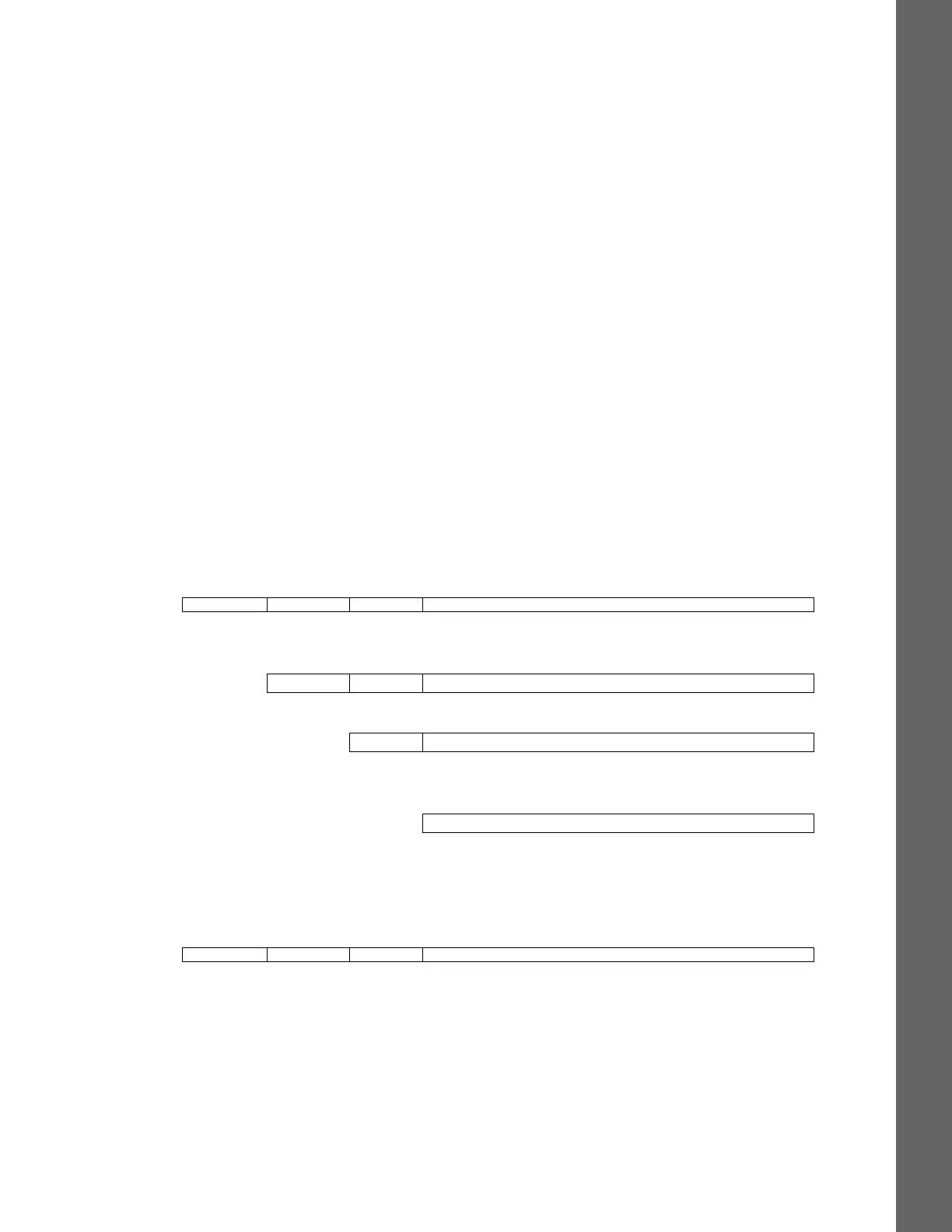
In the relaying of the message addressing is used in the following way:
The above is the data received from the base station terminal device, containing repeater addresses (R1
ADD, R2 ADD) and the substation address (S ADD). Two characters define each address.
The above is the same message after being relayed from repeater 1 to repeater 2.
The above is the same message after being relayed from the last repeater in the chain (repeater 2) to the
substation.
The above is the same message being relayed via the serial interface of the substation radio modem to the
terminal device.
In a situation where the substation transmits data towards the base-station the address is formed in a
similar way, but the order of the addresses is reversed:
In the above, R2 ADD is address of repeater 2, R1 ADD is address of repeater 1 and M ADD is the address
of the base-station.
R1 ADD R2 ADD S ADD DATA
R2 ADD S ADD DATA
S ADD DATA
DATA
R2 ADD R1 ADD M ADD DATA



 To Next Page