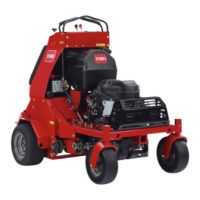
This document is an operator's manual for the Toro 30in Stand-On Aerator, Model No. 29521, with serial numbers 400000000 and up. The manual provides comprehensive information on the safe operation, maintenance, and troubleshooting of the device.
Function Description:
The Toro 30in Stand-On Aerator is designed for aerating lawns in residential and commercial applications, including well-maintained lawns, parks, and sports fields. It is intended for use by trained operators. The machine's primary function is to create aeration plugs in the ground, improving soil health and turf quality. The stand-on design allows for efficient operation and maneuverability.
Important Technical Specifications:
- Height: 132 cm (52 inches)
- Length: 163 cm (64 inches)
- Width: 121 cm (48 inches)
- Aeration width: 76 cm (30 inches)
- Coring range: 5.1 to 12.7 cm (2 to 5 inches)
- Weight: 460 kg (1,015 lb)
- Fuel-tank capacity: 18.9 L (5 US Gallons)
- Engine Oil Type: Detergent oil (API service SJ or later)
- Engine Oil Capacity: 1.7 L (1.8 US qt) with filter removed; 1.5 L (1.6 US qt) without filter removed
- Spark Plug Type: NGK BPR4ES or equivalent
- Spark Plug Air Gap: 0.75 mm (0.03 inch)
- Hydraulic Fluid Specification: AW-32 hydraulic fluid
- Transmission Fluid Specification: Toro® HYPR-OIL™ 500 hydraulic fluid or Mobil® 1 15W-50 synthetic motor oil.
- Battery Voltage: 12 V
- Wheel Lug Nut Torque: 122 to 129 N·m (90 to 95 ft-lb)
- Wheel Hub Nut Torque: 285 to 350 N·m (210 to 260 ft-lb)
- Transmission Output Shaft Nut Torque: 285 to 353 N·m (210 to 260 ft-lb)
- Tire Pressure (Drive Tires): 83 to 97 kPa (12 to 14 psi)
- Grease Type: National Lubricating Grease Institute (NGLI) grade #2 multi-purpose gun grease.
Usage Features:
- Motion-Control Levers: Located on each side of the top console, these levers control the forward and reverse motion of the machine. Wheel speed is proportional to lever movement. Tines rotate when levers are moved out of the NEUTRAL position.
- Throttle Lever: A red lever on the control console to control engine speed. Moving forward increases speed, rearward decreases speed. Full throttle is achieved by moving the lever into a detent.
- Choke Lever: A black lever on the control console to aid in starting a cold engine. Forward position is "On," rearward reduces choke.
- Hour Meter/Tine Engagement Display: Located left of the ignition switch, it monitors engine hours and displays electronic tine-depth settings. The display shows LCD indicators, hour display, and an LED status light.
- Parking-Brake Handle: Located right of the key switch, it engages a parking brake in each transmission. Pulling out and sliding rearward engages; pushing forward into the detent releases.
- Key Switch: Located right of the control console, it has OFF, ON, and START positions for engine control.
- Multi-Function Switch: Located left of the hour meter/tine-engagement display, it allows increasing/decreasing aeration plug depth, locking/unlocking tine-depth setting, and locking/unlocking the tine ground-engagement foot switch.
- LED Status Lights: Multi-colored lights indicating system status (solid green for normal, blinking red for fault, solid red for maintenance required).
- Tines Ground-Engagement Foot Switch: Located on the operator platform, standing on it lowers the tines. Removing the foot raises them. This switch can be disabled for transport.
- Fuel-Shutoff Valve: Located behind the engine, under the fuel tank, it controls fuel flow. Rotate handle to align with fuel line for open, 90° to fuel line for closed.
- Drive-Wheel Release Valves: Located underneath the front of the machine, these allow the machine to be pushed by hand when engaged.
- Smart Controller/Electronic Depth Control: Monitors the electrical system, displays machine hours, interlock status, and maintenance reminders.
- Front Reference/Speed-Control Bar: Adjustable for desired maximum forward speed.
- Zero-Turns: Possible by lifting foot off the tine engagement foot switch control to raise tines. Not recommended when tines are down to avoid turf damage.
Maintenance Features:
- Daily Maintenance: Includes lubricating chains, checking engine-oil level, safety-interlock system, sprockets, chain condition and tension, tines, loose hardware, and cleaning engine/exhaust system and debris from the machine.
- Grease Fittings Lubrication: Front caster pivots (yearly), jackshaft bearings (every 25 hours), wheel bearings (every 25 hours), tine shaft bearings (every 25 hours), tine assembly idlers (every 25 hours), control pivots (every 50 hours), belt idler pivot (yearly), front caster hubs (yearly).
- Chain Lubrication: Before each use or daily, using oil or chain lubricant (not penetrating oil or solvents).
- Engine Oil Service: Change engine oil and filter after first 5 hours, then every 100 hours. Check oil level daily.
- Spark Plug Service: Check, clean, and gap every 160 hours. Replace if worn or damaged.
- Spark Arrester Service: Check every 50 hours for breaks or plugs. Clean with a wire brush or solvent if plugged.
- Fuel Filter Service: Replace every 800 hours/yearly.
- Electrical System Maintenance: Check safety-interlock system daily. Service battery monthly (clean, charge, check terminals). Replace fuses as needed.
- Drive System Maintenance: Check tire air pressure every 50 hours. Torque wheel hub nuts after first 5 hours, then yearly. Torque wheel lug nuts yearly. Torque transmission output shaft nut after first 5 hours, then yearly. Adjust caster pivot bearings pre-load.
- Brake Maintenance: Adjust parking brake and brake switch as needed.
- Belt Maintenance: Check condition and tension of auxiliary pump-drive belt and transmission-drive belt every 50 hours. Adjust auxiliary pump-drive belt tension as needed.
- Controls System Maintenance: Adjust traction-control linkage as needed.
- Hydraulic System Maintenance: Check auxiliary hydraulic-fluid level every 50 hours. Change auxiliary hydraulic reservoir fluid and filter after first 100 hours, then every 250 hours.
- Transmission Maintenance: Check transmission fluid level every 50 hours. Change transmission filters after first 100 hours, then every 250 hours.
- Chain Maintenance: Check condition and tension of jackshaft drive-chain, drive wheel chain, and tine drive chain before each use or daily. Adjust tension as needed.
- Tine Maintenance: Check tines before each use or daily for wear and damage. Remove debris.
- Chassis Maintenance: Check for loose hardware before each use or daily.
- Cleaning: Wash machine with mild detergent and water as needed. Clean engine and exhaust system area before each use or daily. Remove engine shrouds and clean cooling fins every 80 hours. Clean debris from the machine before each use or daily.
- Storage Preparation: Yearly, including raising tines, cleaning, servicing air cleaner, lubricating, changing engine oil, checking/tightening hardware, painting scratched surfaces, and covering the machine.

 Need help?
 General



 To Next Page