HDWA-SVX002C-EN
67
Interval Task
5 years Drain and replace the drive cooling fluid
5 years Replace the fluid strainer when servicing the fluid
Yearly Perform a fluid pH test.
Unit Diagnostics
An improperly filled drive cooling system (either low fluid
level or entrapped air in the circuit) can result in the AFD or
output filter overheating. This condition may result in the
following diagnostics:
• AFD Fault
• Loss of Drive Cooling Control
If chiller diagnostics indicate a drive cooling system
problem, contact your local Trane Service Agency.
pH Test
Obtain a sample of fluid from the drive cooling loop via the
loop drain located near the discharge of the pump. Test for
pH level using litmus paper with a 0.5 resolution.
• pH < 8 indicates fluid to be changed
Pressure Relief Cap
The pressure relief cap is an automotive style pressure-
vent radiator cap; refer to the following figure. The setting
for the relief spring is 16 lb (7.3 kg). The function of the
relief cap can be verified with a standard automotive
radiator cap tester.
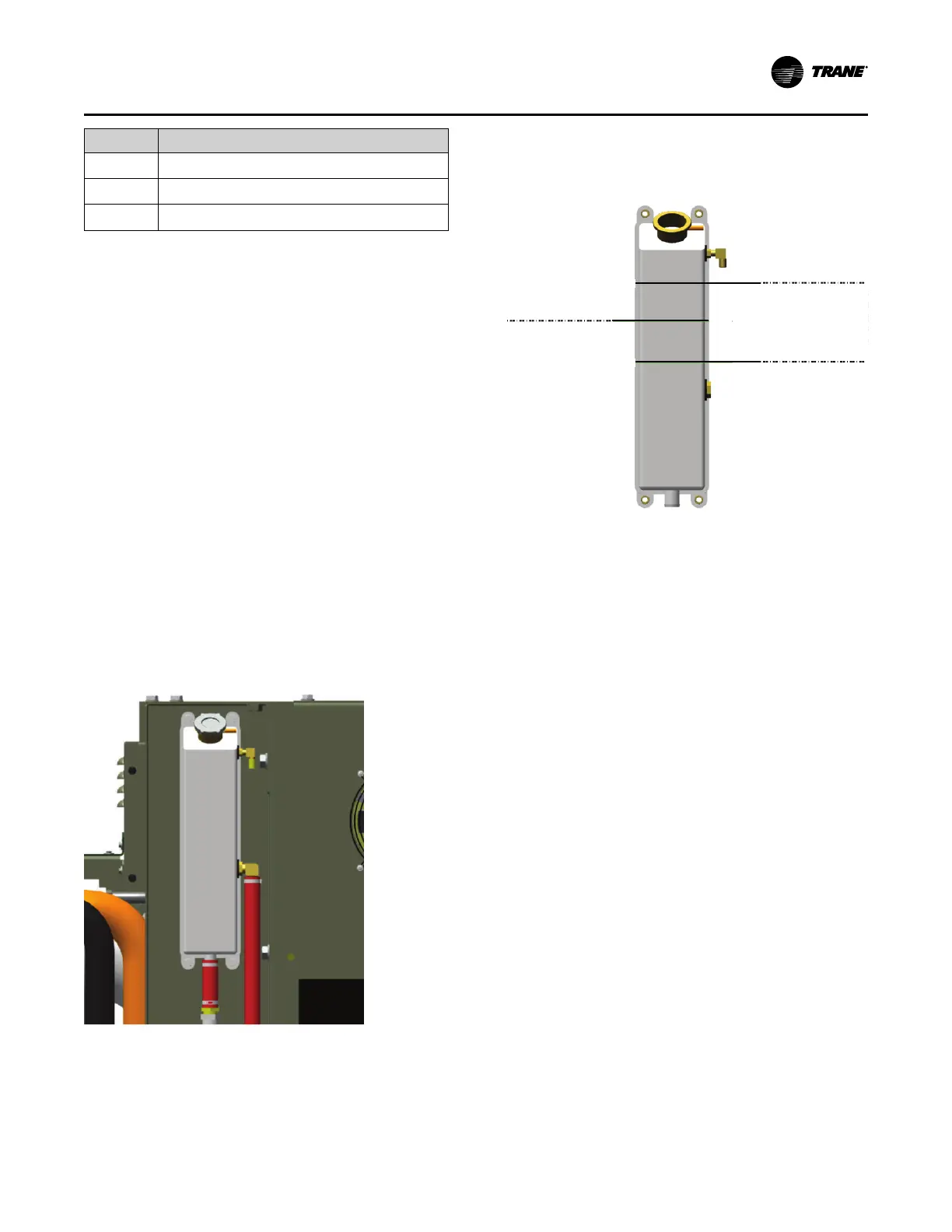
Figure 46. Pressure relief cap
Drive Cooling Expansion Tank
Proper fluid level is important to the operation of the unit.
To verify proper level, inspect the liquid level in the fluid
reservoir (located on the left side of the electrical panel);
refer to the following figure for fluid levels under various
temperature conditions.
Figure 47. Drive cooling expansion tank fill
Design Fill at
104°F (40.0°C)
Maximum Fill at
70°F (21.1°C)
Design Fill at
70°F (21.1°C)
Maximum Fill at
32°F (0.0°C)
Design Fill at
32°F (0.0°C)
Minimum Fill at
70°F (21.1°C)
Note: Fill lines are NOT marked on the tank. The top level
is just below the upper fitting and the bottom level is
just above the lower fitting; the middle level is
midway between the two fittings.
Cleaning the Condenser
Condenser tube fouling is suspect when the “approach”
temperature (i.e., the difference between the refrigerant
condensing temperature and the leaving condenser water
temperature) is higher than predicted.
Condenser tube fouling is indicated when the approach
temperature (the difference between the condensing
refrigerant temperature and the leaving condenser water
temperature) is higher than predicted. Refer to sales order
selection data for approach temperatures.
Note: Glycol in the water system typically doubles the
standard approach.
If the annual condenser tube inspection indicates that the
tubes are fouled, two cleaning methods (mechanical or
chemical) can be used to rid the tubes of contaminants.
The methods are described in the following sections.
Mechanical Cleaning
Mechanical tube cleaning is used to remove sludge and
loose material from smooth-bore condenser tubes.
Maintenance



 To Next Page