48 RT-SVD03G-EN
ReliaTel Test Mode
Protocol of Communications
It is possible, though not recommended, to connect multiple control devices to a ReliaTel system.
The terminal strip is arranged such that simultaneous connection of ICS communication (Tracker,
Tracer, Summit, VariTrac), Mechanical Zone Sensor Module (ZSM), Programmable Zone Sensor,
and a conventional thermostat is possible. Of course, only one device can control the unit at a time.
Following is a protocol of communication; if communication fails, the RTRM seeks the next lower
priority level device. If no device is connected, the unit will not run except during the TEST MODE.
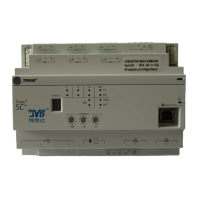
• Highest priority — ICS (Tracker, Tracer, VariTrac, Summit)— Using BAYSENS013, 014, 017 as
needed
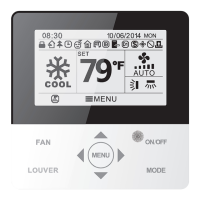
• Next priority — Programmable Zone Sensor (BAYSENS019, AYSTAT666, BAYSENS020)
• Next priority — Mechanical ZSM(BAYSENS006-11B, AYSTAT661-664)
• Least priority —Conventional Thermostat (R, G, Y, W, C)
Although it’s possible to connect multiple devices, doing so increases the chance for error in
application and troubleshooting.
Note: 27½-50 ton VAV- conventional thermostat inputs do not work and are ignored by the RTRM.
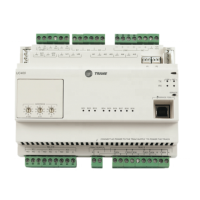
On power up, the RTRM looks for a zone temperature input (J6-1, J6-2). If it doesn’t see one, it then
ignores zone sensor inputs and looks for thermostat (RGYW) inputs.
However, if the unit does see a valid zone temperature input on startup then the thermostat (RGYW)
inputs are ignored. A programmable zone sensor will take priority over either input when
connected, and an ICS system takes the highest priority.
Service Test Mode
Allows the qualified service technician or installer to activate all functions of the unit, regardless
of thermostat, sensor, or in some cases ICS input.
Test Mode is activated using either a fixed resistance or a jumper as explained below.
In Service Test Mode, the unit can be operated in any of several pre-defined operating modes that
exercise all unit functions. The operating modes include Supply Fan On, Economizer open and
close, Cool 1, Cool 2, Cool 3, Reheat Valve (for Staged Dehumidification), Modulating Reheat and
Cooling Valves, Reheat Circuit Pumpout Solenoid, Heat 1, Heat 2, Emergency Heat (heat pumps
only), and Outdoor Coil Defrost (heat pump only).
If a unit does not have a component, such as an economizer, that test stage is skipped.There are
3 ways to use the Test Mode; in each case, the unit can be running in any mode or not running at all.
Service Test Mode can be initiated any time the unit is powered and an open condition has been
detected on the Test Terminals at some time since power-up.
Auto-Cycle Test
Place a jumper from TEST 1 to TEST 2. The unit will run in each mode for 30 seconds, scrolling
through all modes, then exiting the Test mode automatically.
To go through Test Mode again, remove then restore the jumper.
If the jumper is removed at any time during the test mode, the unit will stay in the selected mode
for 1 hour (except for the defrost mode on heat pumps), then revert to normal operation.
Unused states, such as Heat 2 when no Heat 2 is present, shall be skipped.


 To Next Page