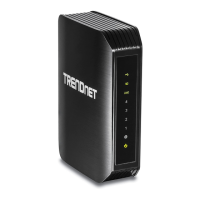
TEW-823DRU
33
© Copyright 2014 TRENDnet. All Rights Reserved.
Congure Firewall Sengs
This router can provide access to devices on your local area network to the Internet using
the Virtual Server, Special Applicaon, method (DMZ NOT recommended).
DMZ
Advanced > Firewall > DMZ
You may want to expose a specic computer or device on your network to the Internet
to allow anyone to access it. Your router includes the DMZ (Demilitarized Zone) feature
that makes all the ports and services available on the WAN/Internet side of the router
and forwards them to a single IP address (computer or network device) on your network.
The DMZ feature is an easy way of allowing access from the Internet however, it is a very
insecure technology and will open local area network to greater threats from Internet
aacks.
It is strongly recommended to use Virtual Server (also called port forwarding, refer to
“Virtual Server” on page 33) to allow access to your computers or network devices from
the Internet.
1 Log into your router management page (refer to “Log in to Management Page” on page 8).
2 Click on Advanced > Firewall > DMZ.
3 In DMZ Sengs secon, select Enable from the DMZ Sengs drop-down list.
4 Enter the IP address you assigned to the computer or network device to expose to the
Internet.
5 Click Apply to save the changes.
ÍNote: To discard the changes, click Reset.
Virtual Server
Advanced > Firewall > Virtual Server
Virtual Server (also called port forwarding) allows you to dene specic ports (used or
required by a specic applicaon) and forward them to a single IP address (a computer or
device) on your network. Using this feature is more secure compared to using DMZ (refer
to “DMZ” on page 33) in which DMZ forwards all ports instead of only specic ports used
by an applicaon. An example would be forwarding a port to an IP camera (TRENDnet IP
cameras default to HTTP TCP port 80 for remote access web requests) on your network
to be able to view it over the Internet. To open several ports please refer to “Gaming” on
page 35.
Since most ISPs constantly change your home IP address, to be able to access the Virtual
Server port(s) from the Internet it is recommended to setup Dynamic DNS service (outlined
in “Idenfy Your Network on the Internet” on page 29).
1 Log into your router management page (refer to “Log in to Management Page” on page
8).
2 Click on Advanced > Firewall > Virtual Server.
3 In Add Virtual Server secon, modify the following sengs:
Rule Enable: Check the opon to enable the virtual server.
Rule Name: Enter a name for the virtual server.
IP Address: Enter the IP address of the device to forward the port. For example,
192.168.10.101.
Protocol: Select the protocol required for your device. TCP, UDP, or Both (TCP and
UDP).
Public Port: Enter the port number used to access the device from the Internet.
Private Port: Enter the port number required by your device. Refer to the connecng
device’s documentaon for reference to the network port(s) required.
ÍNote: The Public Port can be assigned a dierent port number than the Private
Port (also known as port redirecon), however it is recommended to use the
same port number for both sengs. Please refer to the device documentaon to
determine which ports and protocols are required. It is recommended to assign a
stac IP address to the device or use DHCP reservaon to ensure the IP address of
the device does not change.
Inbound Filter: Select the dened IP address range to allow access.
Schedule: Click New Schedule to select the pre-dened schedule to apply. The lter
will only be acve during the me period dened in the pre-dened schedule.


 To Next Page