Need help?
Do you have a question about the UltraGauge EM plus and is the answer not in the manual?
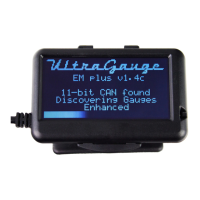
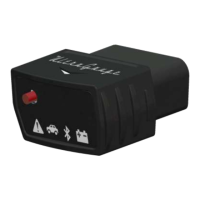
Overview of the UltraGauge device, covering installation and operational aspects.
Critical safety precautions for installing and operating the device, plus product disclaimers.
Instructions for safely cleaning the device's screen without causing damage.
Notices regarding windshield mounting, FCC compliance, and the product's limited warranty.
Procedures for attaching the device using Hook & Loop or Windshield mounting methods.
First-time setup, including engine size, fuel tank configuration, and protocol discovery.
Manually setting the vehicle communication protocol for optimal connection and data retrieval.
Safe operation guidelines, device controls, navigation, and understanding indicators.
Organizing, navigating, and assigning gauges to different display pages and zones.
Information on selecting and viewing the various available vehicle data gauges.
Monitoring engine load, coolant temperature, and fuel trim adjustments for optimal performance.
Tracking RPM, speed, pressures, airflow, O2 sensor voltage, and intake air temperature.
Monitoring MPG, KPL, L/100km, and trip-related distance and speed metrics.
Displaying engine horsepower, kilowatts, and torque measurements for performance analysis.
Estimating remaining driving distance and time based on fuel levels and consumption rates.
Using menus to select gauges, set page formats, and configure display refresh rates.
Procedures for updating fuel levels, configuring the fuel sensor, and estimating fuel.
Fine-tuning fuel usage, distance, and performance metrics for optimal accuracy.
Adjusting Volumetric Efficiency, RPM, and engine efficiency settings for performance tuning.
Configuring power detection modes, battery management, and vehicle compatibility settings.
Controlling backlight brightness, ambient sensitivity, and LCD contrast for optimal viewing.
Setting gauge alarms, audible sirens, and restoring default alarm configurations.
Setting alarms for trouble codes and viewing diagnostic information on the device.
Procedures for clearing the check engine light and managing vehicle trouble codes.
Explaining emission system tests, readiness status indicators, and engine types.
Measuring vehicle acceleration and braking performance metrics for analysis.
Support information, multi-vehicle usage notes, and general troubleshooting guidance.
Details on voltage, interface, protocols, dimensions, and power consumption.
Explanation of OBDII compliance and the location of vehicle emission decals.
Explanation of AFR calculation, its limitations, and the role of Lambda in fuel mixture.
 General
| Display Type | LCD |
|---|---|
| Check Engine Light Reader | Yes |
| Check Engine Light Reset | Yes |
| Compatibility | OBD-II compliant vehicles (1996 and newer) |
| Power Source | OBD-II port |
| Mounting Type | Windshield or dashboard mount |
| Connectivity | OBDII |
| Trip Computer | Yes |
| Data Logging | Yes |
| Alarms | Yes |
| Languages | English |
| Data Parameters | Supports a wide variety of parameters depending on vehicle. Examples: RPM, Coolant Temperature, Intake Air Temperature, Battery Voltage, Fuel Pressure, Manifold Pressure, Throttle Position, Engine Load, Timing Advance, and many more. |

 To Next Page