13
3 Product description
VEGAPULS 63 • Modbus and Levelmaster protocol
41364-EN-170711
3.2 Principle of operation
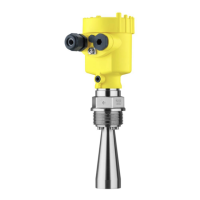
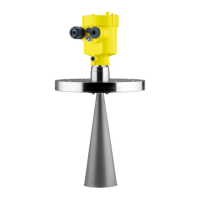
The VEGAPULS 63 is a radar sensor for continuous level measure-
ment of aggressive liquids or with hygienic requirements. It is suitable
for applications in storage tanks, process vessels, dosing vessels and
reactors.
The standard electronics enables the use of instruments in products
withanε
r
value≥1.8.Theelectronicsversionwithincreasedsensitiv-
ity also enables use of the instrument in applications with very poor
reectivepropertiesorproductswithanε
r
value≥1.5.Thevaluesthat
can actually be reached depend on the measuring conditions and the
antenna system i.e. the standpipe or bypass tube.
The antenna of the radar sensor emits short radar pulses with a
durationofapprox.1ns.Thesepulsesarereectedbytheproduct
and received by the antenna as echoes. The transit time of the radar
pulses from emission to reception is proportional to the distance and
hence to the level. The determined level is converted into an appropri-
ate output signal and outputted as measured value.
3.3 Packaging, transport and storage
Your instrument was protected by packaging during transport. Its
capacity to handle normal loads during transport is assured by a test
based on ISO 4180.
The packaging of standard instruments consists of environment-
friendly, recyclable cardboard. For special versions, PE foam or PE
foil is also used. Dispose of the packaging material via specialised
recycling companies.
Transport must be carried out in due consideration of the notes on the
transport packaging. Nonobservance of these instructions can cause
damage to the device.
The delivery must be checked for completeness and possible transit
damage immediately at receipt. Ascertained transit damage or con-
cealed defects must be appropriately dealt with.
Up to the time of installation, the packages must be left closed and
stored according to the orientation and storage markings on the
outside.
Unless otherwise indicated, the packages must be stored only under
the following conditions:
•
Not in the open
•
Dry and dust free
•
Not exposed to corrosive media
•
Protected against solar radiation
•
Avoiding mechanical shock and vibration
•
Storage and transport temperature see chapter "Supplement -
Technical data - Ambient conditions"
•
Relative humidity 20 … 85 %
Application area
Functional principle
Packaging
Transport
Transport inspection
Storage
Storage and transport
temperature





 To Next Page