1.3 Water Chemistry
Water quality is extremely important for the optimum performance of your UV system. The following levels are
recommended for installation:
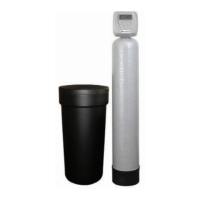
* Where total hardness is less than 7 gpg, the UV unit should operate efficiently provided the quartz sleeve is cleaned
periodically. If total hardness exceeds 7 gpg, the water should be softened. If your water chemistry contains levels in excess
of those mentioned above, proper pre-treatment is recommended to correct these water problems prior to the installation of
your UV disinfection system. These water quality parameters can be tested by your local dealer, or by most private
analytical laboratories. Proper pre-treatment is essential for the UV disinfection system to operate as intended.
WARNING
During extended periods of no water flow, the water in your chamber can become very hot (Approx. 60 °C) and potentially lead to scalding. It is
recommended to run your water until this hot water has been purged from your chamber. Do not allow water to contact your skin during this time. To
eliminate this condition, a temperature management valve can be installed at the outlet of your UV system.
CAUTION
Failure to follow these instructions could result in minor or moderate injury.
• Carefully examine the disinfection system after installation. It should not be plugged in if there is water on parts not intended to be wet such as, the
controller or lamp connector.
• Due to thermal expansion concerns and potential material degradation due to UV exposure, it is recommended to use metal fittings and at least
10" of copper pipe on the outlet of your UV chamber.
NOTICE
• The UV lamp inside the disinfection system is rated at an effective life of approximately 9000 hours. To ensure continuous protection, replace the
UV lamp annually.
• The UV system is not to be used or played with by children. Persons with reduced physical, sensory or mental capabilities, or lack of experience
and knowledge, are also not to handle the UV system unless they have been given supervision or instruction.
• EXTENSION CORDS: If an extension cord is necessary, use only 3-wire extension cords that have 3-prong grounding-type plugs and 3-pole cord
connectors that accept the plug from this system. Use only extension cords that are intended for outdoor use. Use only extension cords having an
electrical rating not less than the rating of the system. A cord rated for less amperes or watts than this system rating may overheat. Exercise
caution when arranging the cord so that it will not be tripped over or pulled. DO NOT use damaged extension cords. Examine extension cord
before using and replace if damaged. DO NOT abuse extension cord. Keep extension cord away from heat and sharp edges. Always disconnect
the extension cord from the receptacle before disconnecting this system from the extension cord. Never yank cord to pull plug from outlet. Always
grasp the plug and pull to disconnect.
• SYSTEM PROTECTION: To protect your Controller, a UL1449 certified (or equivalent) transient voltage surge suppressor is strongly
recommended.
• The UV lamp in this system conforms to the applicable provisions of the Code of Federal Regulations (CFR) requirements including, Title 21,
Chapter 1, Subchapter J, Radiological Health.
• Read and understand the Owner’s Manual before operating and performing any maintenance on this equipment.
Water Quality and Minerals Level
Iron < 0.3 ppm (0.3 mg/L)
Hardness* < 7 gpg (120 mg/L)
Turbidity < 1 NTU
Manganese < 0.05 ppm (0.05 mg/L)
Tannins < 0.1 ppm (0.1 mg/L)
UV Transmittance > 75% (call factory for recommendations on applications where UVT < 75%)
EspecificacionesSafety Information
4
53
Sección 7 Especificaciones
Parámetros de funcionamiento
General (todos los modelos)
Modelos validados de acuerdo con la
normativa NSF estándar 55 Clase B (-V)
Presión máxima de funcionamiento 125 PSI (862 kPa) 125 PSI (862 kPa)
Presión mínima de funcionamiento 4 PSI (27,5 kPa) 4 PSI (27,5 kPa)
Temperatura máxima del aire ambiental 50 ºC (122 ºF) 50 ºC (122 ºF)
Temperatura mínima del aire ambiental 0 ºC (32 ºF) 0 ºC (32 ºF)
Humedad máxima 100% 100%
Dureza máxima 120 ppm (7 granos por 3,79 litros) 120 ppm (7 granos por 3,79 litros)
Nivel máximo de hierro 0,3 ppm 0,3 ppm
Transmisión UV mínima 75% 75%
Instalación Vertical u horizontal* Vertical u horizontal*
Limitador de caudal - Sí
Verificación NSF - Normativa NSF estándar 55 clase B
Ciclo de vida nominal de la lámpara 1 año 1 año
Certificación del sistema UV
Modelo
D4/D4+
D4-V/D4-V+
E4/E4+
E4-V/E4-V+
F4/F4+
F4-V/F4-V+
Caudal
Caudal máximo a una dosis de 16 mJ/cm
2
@
95% UVT
23 gpm (87 lpm) (5,22 m
3
/h) 42 gpm (160 lpm) (9,54 m
3
/h) 45 gpm (170 lpm) (10,22 m
3
/h)
Caudal máximo a una dosis de 30 mJ/cm
2
@
95% UVT
12 gpm (45 lpm) (2,73 m
3
/h) 22 gpm (83 lpm) (5 m
3
/h) 36 gpm (136 lpm) (8,18 m
3
/h)
Caudal máximo a una dosis de 40 mJ/cm
2
@
95% UVT
9 gpm (34 lpm) (2,04 m
3
/h) 16 gpm (60 lpm) (3,63 m
3
/h) 27 gpm (102 lpm) (6,13 m
3
/h)
Caudal máximo según NSF 55 horas, Clase B
(solo versiones -V)
8,9 gpm (33,7 lpm) (2,02 m
3
/h) 15,8 gpm (59,8 lpm) (3,6 m
3
/h) 26,1 gpm (98,8 lpm) (5,93 m
3
/h)
Eléctrico
Voltaje CA de 100 a 240 V CA de 100 a 240 V CA de 100 a 240 V
Frecuencia 50 a 60 Hz 50 a 60 Hz 50 a 60 Hz
Corriente máxima 0,5 Amp 0,85 Amp 1,2 Amp
Consumo eléctrico máximo 50 vatios 83 vatios 130 vatios
Potencia de la lámpara 40 vatios 70 vatios 110 vatios
Otros
Material de la cámara UV 304 SST 304 SST 304 SST
Entrada/salida NPT de 1,905 cm NPT de 2,54 cm (1”) NPT de 2,54 cm (1”)


 To Next Page
 Loading...