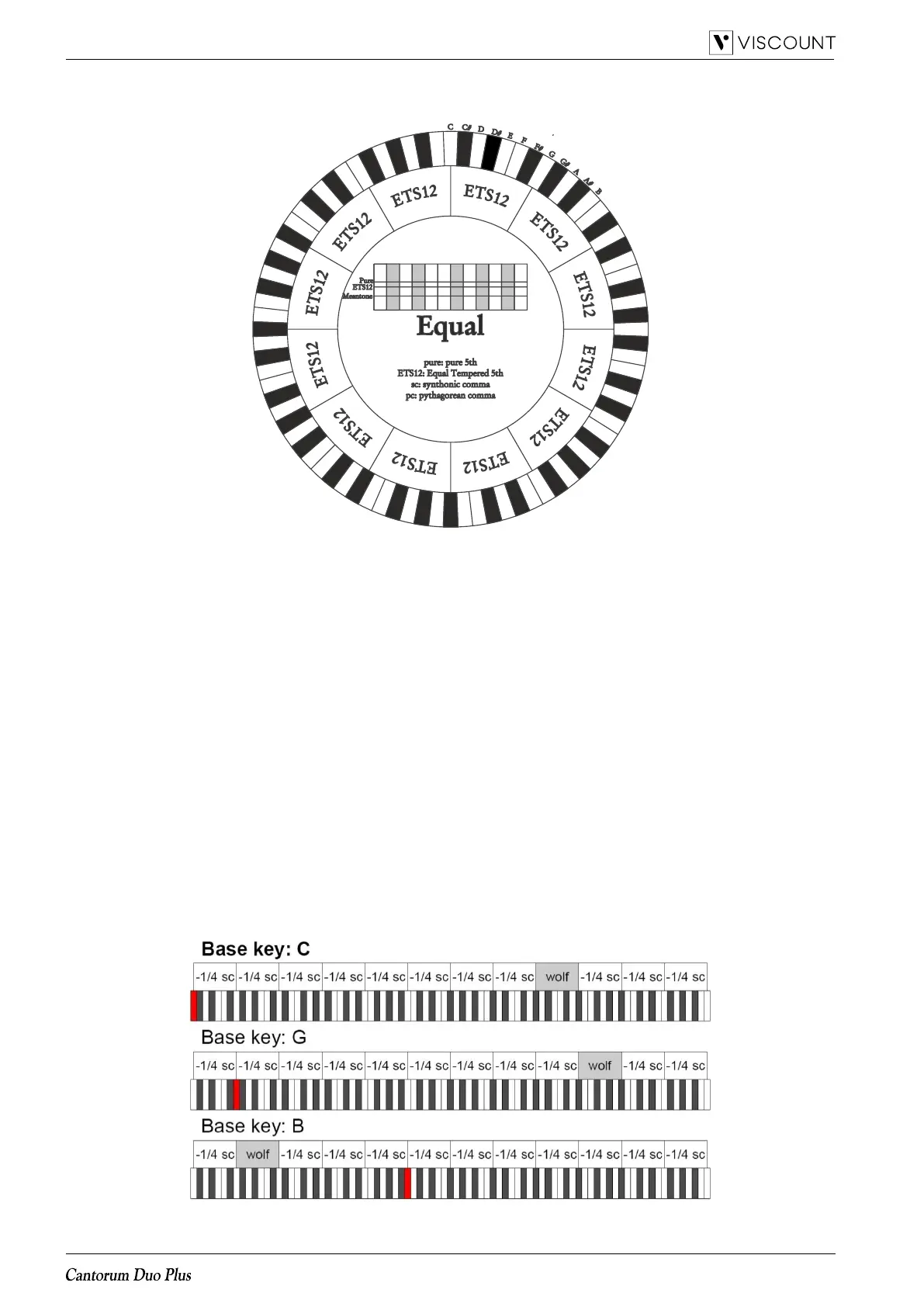
This is the Equal Temperament System (with the comma split in twelve parts).
The Pythagorean comma can be split in larger parts and divided among a few (less than 12) fifths. This leads to
other temperaments, such as the Werckmeister III, which spreads the comma in four, equal parts, between C-G,
G-D, D-A, and B-F#.
A very important interval in the history of tuning is the major third. A chain of four pure fifths makes (3/2)
4
. A major
third interval is represented by a 5/4 ratio. Therefore, rounding off, the frequency of a major third, generated by
Pythagorean fifths is 1,2656, while a natural major third is 1,2500. This surplus is called Syntonic comma.
A series of four fifths, each one reduced by ¼ of Syntonic comma, makes a perfect major third. These fifths are
called “meantone”. If a temperament recovers only one syntonic comma, it still needs to compensate the small
difference between Pythagorean and syntonic comma. This difference is called skisma.
For example, the Kirnberger II temperament is based on the syntonic comma. It spreads the comma equally
between D-A and A-E and the skisma between F# and C#.
A series of three natural major thirds makes a frequency of 5/4^3. The difference between that and the octave is
called enharmonic comma.
When a temperament makes up for more than the Pythagorean comma, usually one fifth is much wider than the
rest and becomes unusable. It is called the wolf fifth.
The circle of fifths of each temperament can start from any key editing the parameter called Base Key.
Follows an explicating graph: in the first half is rapresented Meantone temperament with Base Key set on C, after
on G and finally on B. The second half shows Werkmeister temperament with the same three values of the
Meantone. With the parameter Base Key set to C each temperament is built exactly as shown in the following
circular graphs.



 To Next Page