1.0 SCOPE
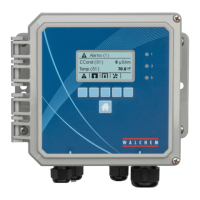
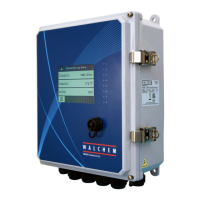
This document is a User Interface Specification for the Walchem Modbus/TCP product feature for W600
and W900 Controllers. It contains mapping of the various dynamic variables to their Modbus/TCP
address locations.
This document supports the Modbus/TCP feature on controller software versions 3.01 and higher.
2.0 INTRODUCTION
The Modbus/TCP feature allows the Walchem controller to communicate with PC-based applications
such as WonderWare and Intellution HMI/SCADA programs, Building Energy Management systems,
Distributed Control Systems (DCS), as well as stand-alone HMI devices.
The controller is a Modbus Server, meaning that it can respond to requests from the HMI device. The
controller cannot initiate the flow of information. For example, it will not immediately send a new alarm
message. It will wait until the HMI device requests the current data contained in specific address
locations.
If the HMI device does not directly support the Modbus/TCP protocol, then a protocol translation
gateway may be required to convert from Modbus/TCP to a protocol that the device supports. Please
note that Modbus/RTU requires a serial interface, not Ethernet, and therefore is not directly compatible
with the Walchem controller.
3.0 OVERVIEW
Modbus/TCP, also known as Modbus TCP/IP, is a form of Modbus that uses the TCP/IP layers as a base
for controlling the communications between different devices. This is not to be confused with Modbus
over TCP/IP, which Walchem controllers do not support.
The Modbus/TCP protocol supports multiple types of data transactions, from reading single bits per
transaction, to advanced object oriented operations. However, to ensure the most compatible system
available, only a basic subset of these functions is supported in the controller.
The official Modbus/TCP protocol supports data addresses 5 digits in length. A de facto extended
standard exists which supports data addresses 6 digits in length. However, to ensure compatibility, the
Modbus/TCP feature supports only 5-digit data address system.
The Modbus/TCP feature supports reading and writing of single-bit Coils and 16-bit Holding Registers, as
well as read-only single-bit Discrete Inputs and 16-bit Input Registers. These data formats allow the
controller to establish blocks that contain all the process variables, set points, alarms, and input/output
status values that are made public to a Modbus/TCP client. These blocks of data are packaged so that it
can be read in 8-bit chunks (for a group of up to 8 Coils or Discrete Inputs) or 16-bit chunks (for a single
Holding Register or Input Register), regardless of the type of data within it. In the following sections, the
formatting, storing, and reading of this data are described.



 To Next Page