Mobile-Assisted Handoff (MAHO)
WHY?
MAHO checks the capability of the mobile to assist the
base station in a handoff. For this purpose the mobile
receives a command to measure signal strength in adja-
cent channels and to report the result back to the base
station.
Requirement
The mobile is able to handle MAHO.
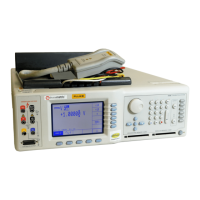
For correct measurement you need a second RF gene-
rator that is able to perform DQPSK modulation, eg a
second STABILOCK 4031/4032.
Make the general test preparations. The channel type
must be To digital TC.
Initiate a call with
{MOBILE}
or
{CELL.}
(the mobile must be
in a digital traffic channel).
Test with 2nd RF generator
HOW?
Press
{MAHO}
in the basic test mask. This calls up the
MAHO test mask and adopts the current DTC number.
Set the RF level in the MAHO test mask to –60 dBm
(standard).
Enter the number of an adjacent channel and the RF
band (800 MHz or 1900 MHz) in the field 2nd DTC.
Couple the second RF generator in addition to the an-
tenna terminal of the mobile and set the frequency of the
selected adjacent channel.
Set the RF level of the second unit to –118 dBm.
Start the test with
{CONTIN}
.
{1-SHOT}
is only useful for a
remotely controlled measurement.
Vary the RF level of the second unit to at least –51 dBm
and look for the test results.
End the test with
{STOP}
.
{RETURN} takes you back to the basic test mask.
Test Results
D
RESULt6 Current BER Bit error rate of mobile in current DTC. Because of strong
–60 dBm signal, (coded) display must be 0 (correspon-
ding to < 0.01% BER, see Table B).
RESULt7 Current RSSI RF signal level of mobile in current DTC (received-
signal-strength indicator). Because of strong –60 dBm
signal, (coded) display must be 27 (corresponding to
–60 dBm, see Table A).
RESULt8 2nd RSSI RF signal level of mobile in defined adjacent channel.
Depending on RF level of second generator, display will
be 0 to 31 (see Table A).
10
Mobile-Assisted Handoff (MAHO) IS-136 MS
10-43



 To Next Page