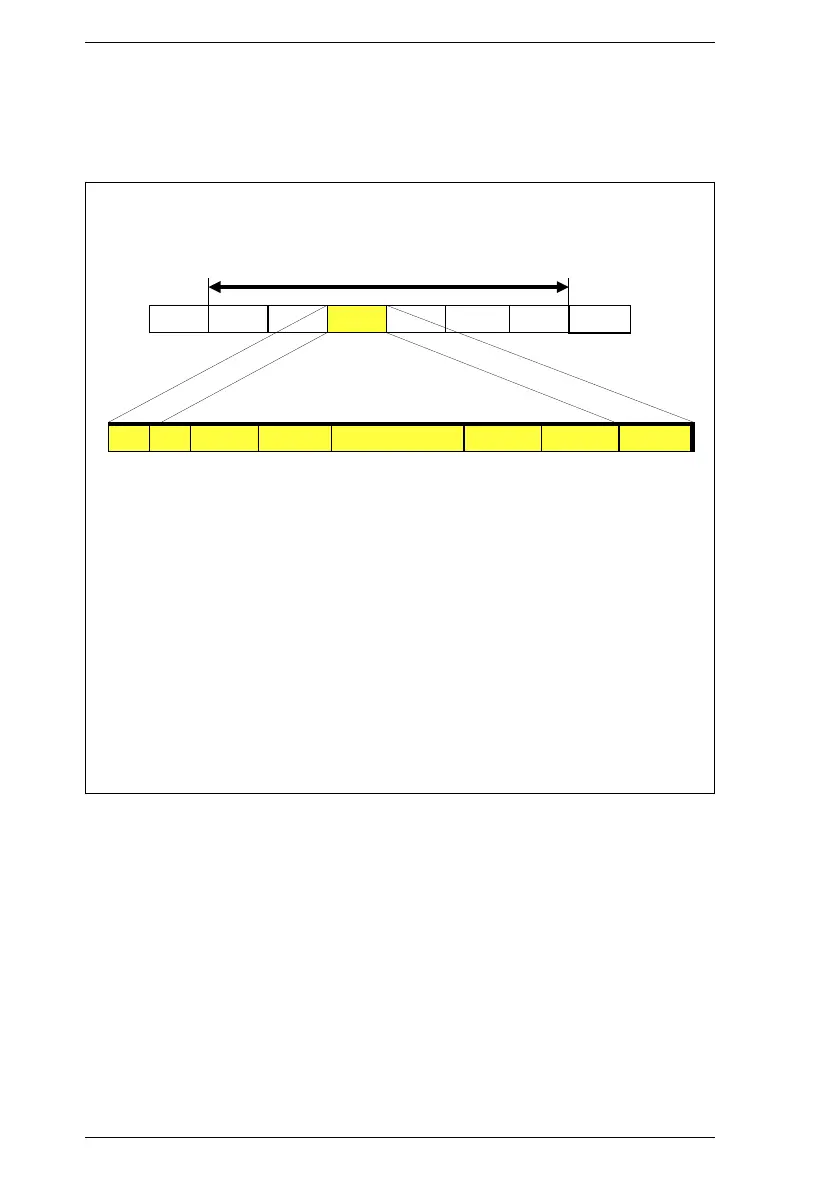
In each time slot the mobile or base station has to ramp its power up and down
at the beginning and end of the time slot within specified limits. The resulting
signal is called a burst. The duration of a burst is 6.66 ms. This is exactly the
duration of a time slot.
Six time slots are refered to as an IS-136 frame with a duration of 40 ms. Each
IS-136 frame carries the information of 1944 bits (972 symbols). This means that
each time slot can carry the information of 324 bits or 162 symbols (mobiles use
only 156 symbols due to guard and power ramp times).
G During the guard time (three symbols) no information is transmitted in a slot.
R The ramp time (three symbols) allows ramping up and down of power.
DATA These fields contain the actual user data (speech).
SYNC This field contains a fixed bit sequence which is needed to demodulate and
decode the burst exactly. In a TDMA system multipath propagation disturbs
the reception of signals as they arrive at different power levels and different
times at the receiver. To allocate the bit stream exactly, a known bit
sequence (SYNC) is used.
SACCH The slow associated control channel is used during a call for signaling
message exchange between the base station and the mobile.
DVCC The digital verification color code is an identification code for the base station
used. If a more distant base station also receives the same mobile, it is
distinguished by the DVCC.
* Including six symbols without information (guard time and ramp time).
Slot 2Slot 1 Slot 1Slot 6Slot 5Slot 4Slot 3Slot 6
DATAG DATADVCCSACCHDATAR SYNC
1 IS-136 frame = 6 slots = 1944 bits (972 symbols)
* = 40 ms
IS-136 frame and slot structure (mobile to base station)
IS-136 MS A Little IS-136 Background Information
10-54



 To Next Page