Welch Allyn, Inc.
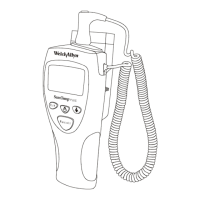
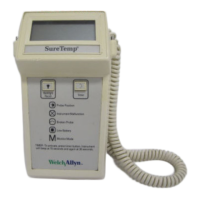
20 SureTemp
®
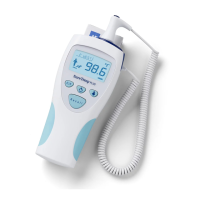
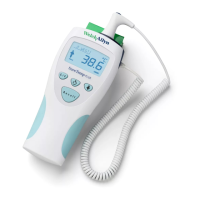
Model 670/SureTemp 4
®
Model 675
The momentary backlight switch (S4) pulls processor pin 39 low. R19 acts as a pull up to return this line
high when not in use. This line is also run to test connector J3 pin 6 to allow automated testing of this
function during factory test.
The processor active high signal is sent out on U2 pin 52 to U1 pin 12 where it is inverted and buffered. This
signal coming out of U1 pin 13 pulls through diode D8 and flex strip J2 pin 21 to the display board mounted
oscillator. The oscillator consists of Q1, Q2, C5, R1, R2, T1 and the lamp itself.
If the thermometer is not in the process of taking a temperature, the Backlight/Recall switch will wake up the
thermometer and display the last recorded temperature.
Horn
The horn is activated at the start of a temperature taking cycle, at the end of a Normal mode temperature
cycle, during timer operation at 0, 15 and 30 seconds, and for various error conditions.
A short duration high pitch single beep is indicative of normal operation. A short duration lower pitch double
beep is used to indicate errors such as switching from Monitor mode to Normal mode during a temperature
cycle.
The horn is a piezoelectric ceramic resonator driven by a processor square wave buffered through U1. The
horn control signal comes from U2 pin 12 and enters U1 pin 3 where it is buffered and inverted and sent out
on pin 1 directly to the horn LS1.
F/C Switching
The F/C switch (S2) sets the processor pin 11 via resistor R6 high or low for F or C respectively. This line is
also run to the test connector J3 pin 3 to allow automated testing of this function during factory test. R6
allows this line to be pulled high or low at J3 during factory test regardless of the position of the switch.
Timer
The 30 second timer is started or stopped at any time by pressing the Timer switch (S5). This pulls
processor pin 40 low momentarily. This line is also run to test connector J3 pin 5 to allow automated testing
of this function during factory test. Resistor R10 returns this line high when not in use.
ERROR CODES
Error codes fall into three categories. Transitory, Recoverable and Non-Recoverable.
Transitory errors are generated by external events and are not errors generated by the thermometer. They
do require that temperature measuring be inhibited until the error is cleared. There is no limit to the number
of times a transitory error can occur. All probe problems are considered by the thermometer to be external
events and are therefore classified as transitory.
Recoverable errors are generated from internal test failures, which are non-catastrophic and require that
temperature measuring be inhibited until the error is cleared. A recoverable error will be promoted to a non-
recoverable error if it occurs four times sequentially. After displaying the error code and any appropriate
icon, the instrument will reset itself and attempt to resume normal operation. After the fourth attempt to clear
itself, the error becomes non-recoverable.


 To Next Page
 Loading...