3.6.2 3.6.2. NAT
Network Address Translation (NAT)
In computer networks, Network Address Translation (NAT) is the collective term for procedures that automatically
replace address information in data packets with other information in order to connect dierent networks. For this
reason, they are typically used on routers.
Use of Source NAT
It allows devices with private network addresses to connect to the Internet. Private IP addresses cannot usually be
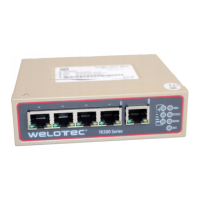
routed by the provider, so they must be translated into a public, routable IP address. The TK800 has implemented
this function, which enables communication between dierent networks. In addition, a relevant security aspect is
found in NAT, since a public IP address cannot be traced back to the associated private IP address. This function is
configured in the TK800 router at the factory.
Use of Destination NAT
This is used to provide server services running on computers under a single IP address. It is oen referred to as port
mapping or port forwarding. This function must be explicitly set up on the TK800.
Use of 1:1‑NAT
A special form of destination NAT is 1:1 NAT. It is used, for example, when a central location wants to access dier‑
ent sites via VPN, which are all configured with the same IP network addresses. This is frequently encountered in
machine networks.
Configuration
• to configure NAT, go to the Firewall menu item and select NAT
• here you can find a list of all existing NAT rules and the definition of the Inside‑(LAN‑) and Outside‑(WAN‑) inter‑
faces
(Note: For some use cases it is necessary to create and use an ACL (Access Control List))
Welotec GmbH
Zum Hagenbach 7
48366 Laer
www.welotec.com
info@welotec.com
+49 2554 9130 00
Page 96



 To Next Page