Need help?
Do you have a question about the Wfly WFT09 and is the answer not in the manual?
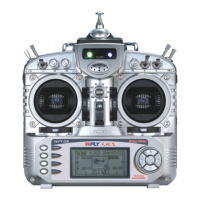
Details the front panel components and controls of the WFT09 transmitter.
Describes the rear side of the WFT09 transmitter, including ports and covers.
Information on the WFR09-P PPM receiver, its channels, and specifications.
Details the WFR09-C PCM receiver, its channels, and operating parameters.
Explains the function and meaning of the indicator light on the receiver.
Step-by-step guide on how to set up and use the trainer function for data transfer.
Explains the function of the MENU button to access transmitter functions.
Describes the EXIT button's role in backing out of menus or edits.
Details the use of the '+' button for increasing values and speed.
Explains the use of the '-' button for decreasing values and speed.
Describes the function of cursor buttons for navigation.
Explains the OK button's function for confirmation and entering menus.
System settings for helicopter models, including model selection and naming.
Detailed guide on setting up normal (7-point) and advanced (user-defined) curves.
Basic operational settings for helicopter flight modes.
Advanced settings and flight control functions for helicopters.
Overview of navigating menus and functions for system settings.
How to select one of the ten available helicopter models.
Procedure for creating custom names for helicopter models.
Guide to setting the model type (Heli, Acro, Glid) for the helicopter.
Explanation of the Adjustable Travel Limit (ATL) function for throttle.
Setting the receiver modulation (PPM/PCM) to match the transmitter.
Options for selecting swash plate types (e.g., 120, 90 degree CCPM).
Configuration of stick modes (e.g., Aileron, Elevator, Throttle, Rudder).
Function to restore default settings for various parameters.
Method for transferring model data between transmitters via cable.
Process for receiving model data from another transmitter.
Adjusting the LCD screen brightness and contrast.
Option to select the display language (Simplified Chinese or English).
Introduction to curve setting functions and types.
Step-by-step guide for configuring normal and advanced curves.
Displays servo movement status for PCM/PPM outputs.
Adjusts control sensitivity (dual rate) and stick response (exponential).
Changes the direction of servo movement (normal or reverse).
Sets the maximum travel limit for individual servos (0% to 120%).
Fine-tunes the neutral position of servos for precise centering.
Adjusts aileron, elevator, and pitch travel range in swash mixing.
Configuration for channels 5 through 9, including switch/knob assignments.
Sets throttle curves for different flight modes (NORM, IDLE1, IDLE2, IDLE3).
Configures pitch curves for engine performance in various flight modes.
Mixes opposite rudder input to counteract blade pitch changes.
Adjusts the rate at which trim levers move the trim value.
Function to shut off the engine at the end of a flight.
Selects the flight mode for different flying scenarios.
Sets servo operation speed and mix rate for throttle holding.
Configures transmitter response in case of signal loss or low battery.
Functions for setting and managing flight timers (countdown/increment).
Selects the display language for the transmitter interface.
Adjusts gyro sensitivity for AVCS gyro (GY) and normal gyro (STD).
Fine-tunes throttle performance around the center point for hovering.
Fine-tunes pitch performance around the center point for hovering.
Sets high and low pitch positions for different flying modes.
Automatically adjusts servo trim at hovering state for helicopters.
Delays aerobat or throttle cut for smooth transitions during flight.
Sets the governor function to adjust governor speed settings.
Adjusts throttle and pitch mix function for flight control.
Options for normal and advanced curve settings.
Mix programs for various flight poses and configurations.
Curve mix programs for detailed flight parameter adjustments.
Pre-programmed mix for engine tuning and response.
System settings for airplane models, covering basic configurations.
Basic operational settings for airplane flight modes.
Advanced settings and flight control functions for airplanes.
Overview of navigating menus and functions for system settings.
How to select one of the ten available airplane models.
Procedure for creating custom names for airplane models.
Guide to setting the model type (Heli, Acro, Glid) for the airplane.
Explanation of the Adjustable Travel Limit (ATL) function for throttle.
Configuration for the AIL-2 channel, an additional aileron channel.
Setting the receiver modulation (PPM/PCM) to match the transmitter.
Configuration of stick modes for airplane controls.
Function to restore default settings for various parameters.
Method for transferring model data between transmitters via cable.
Process for receiving model data from another transmitter.
Adjusting the LCD screen brightness and contrast.
Selects the display language for the transmitter interface.
Displays servo movement status for PCM/PPM outputs.
Adjusts control sensitivity (dual rate) and stick response (exponential).
Changes the direction of servo movement (normal or reverse).
Sets the maximum travel limit for individual servos (0% to 120%).
Fine-tunes the neutral position of servos for precise centering.
Configuration for channels 5 through 9, including switch/knob assignments.
Sets throttle curves for different flight modes (NORM, IDLE1, IDLE2, IDLE3).
Adjusts the rate at which trim levers move the trim value.
Flaperon mixing function for simultaneous aileron and flap control.
Assigns primary flaperon control for trimming flap action.
Aileron differential for controlling aileron operation on 2-servo wings.
ELEV-FLAP mixing for dropping/rising flaps with elevator movement.
Function to shut off the engine at the end of a flight.
Lowers engine idle for running, takeoff, stalls, and landings.
Configures transmitter response in case of signal loss or low battery.
Functions for setting and managing flight timers (countdown/increment).
Selects the display language for the transmitter interface.
Options for normal and advanced curve settings.
Mix programs for various flight poses and configurations.
Curve mix programs for detailed flight parameter adjustments.
Mixes flaps and ailerons for steep descents or airspeed control.
Elevon mixing for delta wings, combining aileron and elevator functions.
Ailevator mixing for combining aileron and elevator functions.
V-tail mixing for combining elevator and rudder functions.
Executes snap rolls via a switch, simplifying complex maneuvers.
Slows throttle servo response to simulate turbine engine behavior.
Pre-programmed mix for engine tuning and response.
Adjusts gyro sensitivity for AVCS gyro (GY) and normal gyro (STD).
 General
| Brand | Wfly |
|---|---|
| Model | WFT09 |
| Category | Remote Control |
| Language | English |

 To Next Page