Shadow 8 User Manual 1139300
Operation 3-5
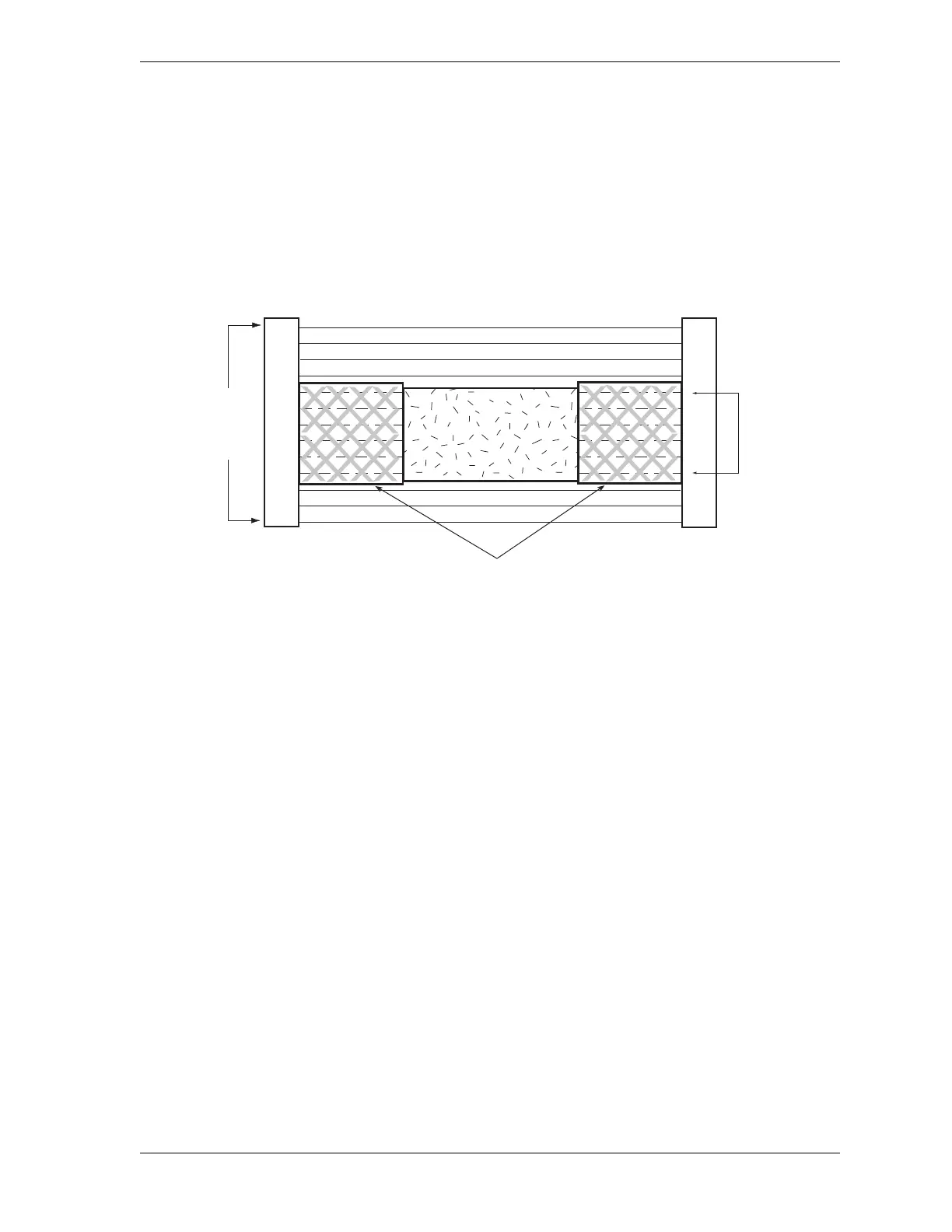
Shadow 8’s fixed blanking feature is useful in situations where, for example, a conveyor or
work table extends into the sensing field and moving the fixture may not be feasible. You
program a blanking window at the Shadow 8 control or WPC press control for the area of the
sensing field penetrated by the fixture, disabling the light beams that would normally detect
the fixture. Areas above and below the fixture remain guarded, so if they are penetrated,
Shadow 8 sends a stop signal to the machinery.
Fixed blanking windows must remain obstructed. If the obstruction is removed, the Machine
Run/Stop LED is illuminated red.
More than one fixed blanking window may be programmed for a standalone pair of light
curtains as long as the number of consecutive unobstructed beams required for that Shadow 8
model is satisfied. When a light curtain system consists of as many as four pairs of heads,
additional fixed blanking windows can be programmed as long as 7 to 9 consecutive beams on
Main heads and 2 consecutive beams on Extension heads remain unobstructed. This
requirement is the same as the consecutive beam rule that obtains for head alignment (see
page 2-49). When the rule is not satisfied, the Machine Run/Stop LED flashes red and the
Blanking Active LED flashes amber at the same time.
The number of consecutive beams that must remain clear on Main heads depends on the
number of beams in the light curtain. A minimum number of consecutive beams must remain
clear to allow Shadow 8 receiver(s) and transmitter(s) to synchronize their sequencing (see
Shadow 8 Operation, page 1-6). Table 3-1, page 3-6 shows the number of consecutive beams
that must remain unblanked for each model of Shadow 8 Mains and for all models of Shadow
8 Extensions.
Figure 3-1. Using Supplemental Guarding with Fixed Blanking Windows
Obstruction
Fixed blanking window
Sensing field
Light curtain Light curtain
Guarding



 To Next Page