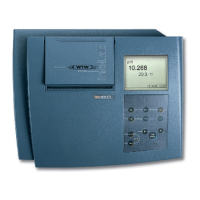
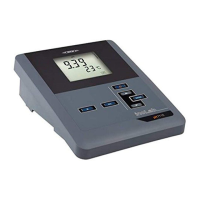
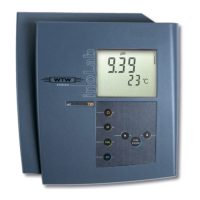
pH 7310 pH value
ba75929e02 10/2011 25
5.2 Calibration
5.2.1 Why calibrate?
pH electrodes age. This changes the zero point (asymmetry) and slope of the
pH
electrode. As a result, an inexact measured value is displayed. Calibration
determines and stores the current values of the zero point and slope of the
electrode.
Thus, you should calibrate at regular intervals.
5.2.2 When do you have to calibrate?
After connecting a sensor
Routinely within the framework of the company quality assurance
When the calibration interval has expired
5.2.3 Automatic calibration (AutoCal)
Make sure that in the sensor menu, Buffer menu, the buffer set is correctly
selected (see
7.1.1 CHANGING THE SETTINGS FOR PH MEASUREMENTS, PAGE 38).
Use any one to five buffer solutions of the selected buffer set in ascending or
descending order.
Below, calibration with Technical buffers (TEC) is described. When other buffer
sets are used, other nominal buffer values are displayed. Apart from that, the
procedure is identical.
If single-point calibration was set in the menu, the calibration proce-
dure is automatically finished with the measurement of buffer solu-
tion 1 and the calibration record is displayed.
1. Connect the pH electrode to the meter.
2. Keep the buffer solutions ready.
When measuring without temperature sensor:
Temper the buffer solutions or measure the current temperature.
3. In the measured value display, select the measured parameter pH or mV
with <M>.
4. Start the calibration with <CAL>.
The calibration display for the first buffer appears (voltage display).


 To Next Page