OPERATION
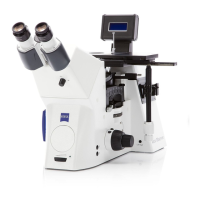
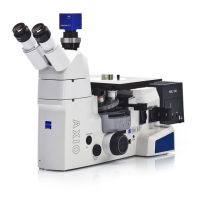
Axio Observer Illumination and contrast techniques ZEISS
12/2016 431004-7244-001 157
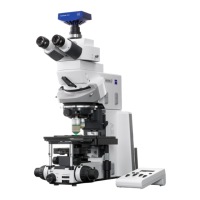
Key to Fig. 154:
1 Microscope stage
2 Aperture diaphragm slider MAT in slot A
3 Iris diaphragm slider for reflected light (as luminous-field diaphragm) in slot F
4 LM-Set button
5 Nosepiece
6 Compensator mount 6x20
7 Reflector turret
8 Optovar turret selector wheel
9 Coarse / fine focus drive
10 RL button for switching the LED / halogen illuminator or the reflected light shutter (fluorescence) on and off
11 Control wheel for LED light / halogen illuminator intensity control
12 Rotary / sliding button for vis / doc beam splitting
13 Rotary / sliding button for Bertrand lens and manual shutter
14 Binocular section of the tube
15 Eyepiece
16 Eyepiece focusing ring
17 Standby button
18 Analyzer slider slot
19 Sideport selector wheel
20 Light path selector wheel (baseport / vis / frontport)
21 Mounting frame K for reflected light with inserted stage pinhole aperture
22 Holder with LCD display
(1) Application
The reflected-light bright field microscopy is the simplest and most widely used microscopy technique
which is used to examine opaque samples or specimens e.g. polished sections or wafers.
For a true-to-object imaging, indirect ray bundles, i.e. ray bundles diffracted and scattered on the
specimen details, are of major importance in addition to the so-called direct ray bundles. The higher this
portion of indirect rays (aperture), the more realistic the microscope image will be, according to ABBE's
rule.
The incoming, bundled light from the reflected-light illuminator is reflected by a neutral-colored beam
splitter. Then it passes to the objective which focuses the beams onto the specimen surface (so-called
condenser function). The objective collects the light reflected by the object and generates the
intermediate image of the microscope together with the tube lens, which is then observed visually or can
be documented objectively.
(2) Instrument equipment
− Axio Observer materials with attached microLED or adjusted HAL 100 illuminator
− Reflector module H P&C in reflector turret
− EC Epiplan, EC Epiplan- Neofluar objective



 To Next Page