VIII SERVICE ACTIVITIES
1. INDICATIONS FOR HEATBED CALIBRATION
The calibration process of the heatbed (heatbed scan) is not required every time the printer is started - it is enough to carry it
out every few dozen to several hundred hours of printing. The heatbed calibration process is described in chapter III, point 3.1.
Calibrate the heatbed if any of the below symptoms occur:
• the printer is to be started for the first time,
• one or more corners or edges of the printout get unstuck or do not adhere to the heatbed,
• one or more corners or edges of the printout are pressed into the heatbed surface (the impression of transparency),
• too thinly applied layer, eventually, skipping, clicking of the extruder motor, accumulation of excess material between the
hotend passages,
• the heatbed surface has been unintentionally lifted,
• large force has been applied, for example, when removing the printout, and there is a reasonable suspicion that it has
been relocated,
• the first layer seems to be unevenly distributed - one edge is correct while the opposite one is crushed or does not adhere
to the heatbed strongly enough.
1.1. Heatbed change
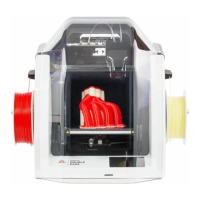
3DGence DOUBLE P255 printer has a ceramic heatbed. Such a solution guarantees good adhesion of the first printout layer and
easy removal of the model after the printing process. The ceramic heatbed of 3DGence DOUBLE P255 printer can be quickly
changed as described below.
To prevent damage to the ceramic heatbed, do not remove printouts from the heatbed too quickly, before the heatbed has
cooled down. If the adhesive agents not recommended by 3DGence are used, the ceramic heatbed may crack or even a piece
of the ceramic surface may be torn away.
Change of ceramic surface of the heatbed:
1. Switch the printer on and make certain that the heatbed temperature is lower than 30
o
C.
2. Lower the heatbed (MENU → LOWER HEATBED) so that you get free access to the heatbed from the top.
ATTENTION: the heatbed downward movement by means of LOWER HEATBED option is unlimited! Take special care
when using this option to prevent the collision of the heatbed with the printer's lower plate.
3. Switch the printer off and disconnect the power lead.
4. Remove four metal clips fastening the ceramic surface by sliding them off (fig. 57, yellow colour, point 1). If it is difficult to
remove the clips, use pliers.
5. Gently raise the ceramic surface upright (fig. 57, red colour, point 2).
6. Gently install a new, clean ceramic surface and fix it with clips.
7. Clean the ceramic surface (chapter IV, point 4.2).
8. Calibrate the heatbed: Menu → Advanced → Heatbed scan.


 To Next Page