Model slicing (slicing) – the process aimed at generating paths and instructions for the printer (machine code, G code) from a
three-dimensional model. At the slicer level, such settings as layer height, printing speed, filling density, solid wall thickness or
temperatures for the nozzle and the heatbed are selected. In addition, the application and density of supports and one of the
several methods of improving the adhesion of the printout to the heatbed (e.g. raft or brim) can be selected. 3DGence DOUBLE
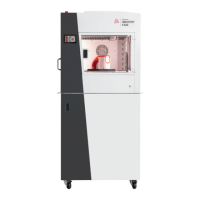
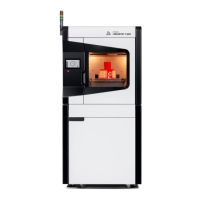
P255 printer uses the 3DGence Slicer software in which settings for various nozzles and resolutions have been defined. The
final product of the slicers is the machine code representing a given 3D model in the form of a G code (g-code, * .GCODE),
which is interpreted by the printer's electronic system.
Nozzle – the hotend's element in direct contact with the printout. The nozzle heated up to the temperature proper for the
given material melts the material and forms a thread of plastic with the diameter equal to the nominal diameter of the nozzle.
As standard, 3DGence DOUBLE P255 printer is equipped with two nozzles with the diameter of 0.4 mm. The nozzle output
diameter has influence on the available resolutions, speed and accuracy of printing.
Extruder – a component of a FFF 3D printer. Its task is to feed the filament at a precisely defined speed and, consequently,
amount. 3DGence DOUBLE P255 printer is equipped with the Bowden type extruder. This means that the extruder motors are
located outside the moving parts of the printer and the filament is pushed to the hotends through Teflon tubes. The use of the
Bowden type extruders lightens the printer structure and has beneficial impact on printing quality.
Endstop (limit switch) – optoelectronic switch that restricts the 3D printer movements to the allowable limits. 3DGence
DOUBLE P255 printer is equipped with 3 optical endstops – one for each axis. The optical endstop does not require the physical
contact with the corresponding breaker, which guarantees its long life. However, attention should be paid to its sensitivity to
sources of bright light, which can cause false activation.
Filament – popular name of the material for printing in FFF technology. Filament is a wire made of a thermoplastic (PLA, ABS,
PVA, HIPS, PC, Nylon and others) within a specified tolerance. Filament is wound on spools. The important parameters for
selecting a filament are as follows: manufacturing tolerance and the method of protection against moisture (optimally, the
filament should be vacuum packed together with a moisture absorber). A large inner diameter of the filament spool guarantees
that the entire length of the filament will be used – excessive bending of the filament (e.g. on a small inner diameter spool)
may hinder the filament use. Once the filament package is opened, the filament should be stored in a dark, dry place with a
moisture absorber.
Firmware – internal software of 3D printer. It is responsible for interpreting the commands contained in the machine code
(G code). Firmware generates basic signals for heaters, motors and fans. It is responsible for the interpretation of accelerations,
temperature correction tables and many other factors. Well-tuned firmware is an important element of the printer calibration,
because it is responsible for the adjustment of pick-ups, accelerations and other parameters of key importance for good
performance of the printer.
G-Code – standardized programming language for controlling the machines used in computer-aided manufacturing (CAM).
Shortly speaking, a sequence of G code contains exact instructions for the machine - in which direction, how fast and along
which axis it should move. The code for printers is generated by slicing software (slicers). The code contains all data on
temperatures of subassemblies and motor rotations in the precise sequence for controlling the hotend movements and the
extruder operation. The code commands are sent line by line to the processor of the printer's controller during printing. The
processor, based on its firmware, interprets the code and sends appropriate signals to subassemblies.
Missing steps – in wrong working conditions of the printer's motor and controller (e.g. excessive temperature, mechanical
resistance), the motor's steps may be missed. The symptom of this phenomenon is the print plane shifted on the axis whose
motor has lost its steps. The visual effects of this fault depend on the path on which the hotend moves relative to the heatbed.
To better imagine this, let's assume that the printout is a cube and the printer has lost steps in the middle of the printing
process. The printed object would look as if it was cut halfway through on the XY plane and glued together with a displacement.


 To Next Page