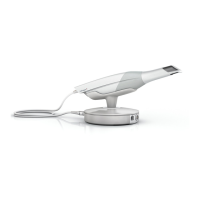
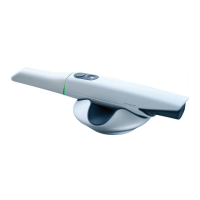
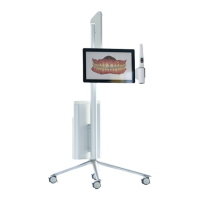
9
ENGLISH
5.5 Eye safety
WARNING
The scanner emits bright light from its tip during operation.
The scanner complies with EN (IEC) 62471 (Photobiological
safety of lamps and lamp systems). However, we
recommend caution when handling the scanner.
A brief glimpse of the light into the eye is not dangerous,
but do not stare into the beam or view directly with optical
instruments, and do not aim the beam towards other people’s
eyes. In general, intense light sources have a high secondary
exposure potential due to their blinding effect. As is also true
when viewing other bright light sources (e.g. headlights),
temporary reduction in visual acuity and afterimages can
occur, leading to irritation, annoyance, visual impairment,
and even accidents, depending on the situation.
5.6 Hygiene
WARNING
To maintain a clean work environment and the safety of the
patient, wear clean surgical gloves when:
• Handling the scanner tip – changing the tip or setting/
flipping for upper/lower scans or handling the mirror.
• Handling the protection tip.
• Handling the color calibration kit.
• Applying the TRIOS for scanning patients.
• Touching the TRIOS IOS system.
WARNING
Always clean the scanner unit and its optical window before
attaching the protection tip. Do not allow patient contact
with the protection tip.
WARNING
Always have the scanner-tip mounted when inserting the
scanner into the patient’s mouth or in any way in contact
with the patient. Mounting of the scanner tip is always
required for maximal electrical safety and due to the risk
of contamination.
WARNING
Always have a cleaned and sterilized scanner tip mounted
before attaching the color calibration adaptor. Do not allow
patient contact with the color calibration kit.
WARNING
Before each patient, you must:
• disinfect the system,
• apply a new sterilized or high-level disinfected tip
to the scanner.
See the detailed instruction in the chapter below.
System S2P (pod) only:
WARNING
Before each patient, make sure any PC connected
to the system and its peripherals are disinfected.
It is recommended to use medical-grade peripherals
(e.g., keyboards and mice) that can be disinfected easily
5.7 Safety when scanning with TRIOS
CAUTION
The handheld scanner is a highly precise optical instrument
and must be handled carefully. Do not drop, shake or bump
the handheld scanner, as these actions could cause it to
break or malfunction. Follow these guidelines:
• Always return the handheld scanner to its mount when
not in use.
• Do not submerge the handheld scanner in any liquids.
• Do not place the handheld scanner on heated or wet surfaces.
• Grip the handheld scanner firmly during scanning
and when removing / returning it to its mount.
NOTICE
The scanner will get warm during use. This is normal but
not part of any patient treatment.
CAUTION
The handheld scanner tip is fragile and contains a delicate
mirror. To avoid damage to the tip and mirror, take care not
to bump the tip onto the patient’s teeth or restorations.
CAUTION
When the TRIOS system is used for pediatric patients please
pay extra attention while scanning the patient.
5.8 Protection from overheating
WARNING
The handheld scanner may become uncomfortably warm
if operated continuously for a prolonged time.
In the unlikely event that more than 30 minutes of scanning
is needed, stop scanning after 30 minutes and allow at least
10 minutes to cool, before scanning is resumed.
WARNING
The ventilation openings in the rear of the handheld scanner
must never be blocked or obstructed.
If overheated, the scanner may become uncomfortably warm
and eventually shut down.
WARNING
Ventilation openings must never be blocked or obstructed.
There are openings at the back of the display. At the top and
bottom of the computer unit. If overheated, the system may
stop functioning.
6. Cleaning, Disinfection,
and Sterilization
6.1 Cleaning, disinfecting and sterilizing
the scanner tip
The TRIOS scanner tip is the part of the scanner that is inserted into the
patient’s mouth during scanning. The tip can be reused a limited number of
times, but it must be cleaned and sterilized between patients to avoid cross
contamination.
The tip can be removed by pulling it away from the scanner body.


 To Next Page
 Loading...