119
INSTALLING A CHILD
RESTRAINT SYSTEM
WITH SEAT BELTS
96) 97) 98) 99)
The Universal child restraint systems
installed with the seat belts only are
type-approved on the basis of the ECE
R44 standard and are divided into
various weight groups.
WARNING The figures are indicative
and provided for assembly purposes
only. Fit the child restraint system
according to the instructions, which
must be included.
WARNING Following an accident of a
certain importance, it is recommended
to replace both the child restraint
system and the seat belt to which it
was bound.
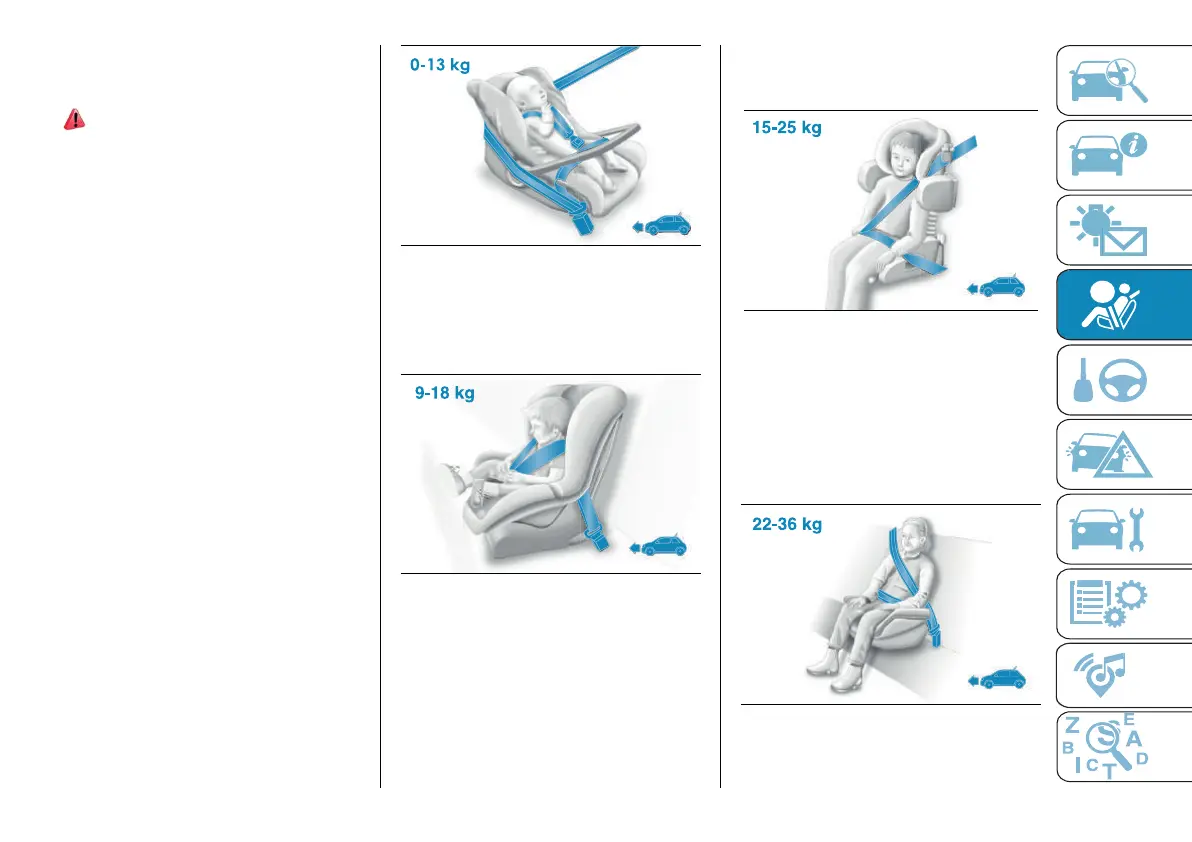
Group 0 and 0+
Infants up to 13 kg must be carried
with a rearward facing child restraint
system of the type shown in fig. 112
which, supporting the head, does not
induce stress on the neck in the event
of sudden decelerations.
The child restraint system is restrained
by the car seat belts, as shown in
fig. 112 and it must restrain the child in
turn with its own belts.
112 F0S1253
Group 1
Children weighing from 9 to 18 kg may
be transported in forward facing child
restraint systems fig. 113.
113 F0S1255
Group 2
Children from 15 to 25 kg may be
restrained directly by the car seat belts
fig. 114.
In this case, the child restraint system
is used to position the child correctly
with respect to the seat belts so that
the diagonal belt section crosses the
child’s chest and not the neck, and the
lower part is snug on the pelvis not the
abdomen.
114 F0S1257
Group 3
For children between 22 and 36 kg,
there are dedicated restraint systems
that allow the seat belt to be worn
correctly.
The fig. 115 shows the correct child
positioning on the rear seat.
115 F0S1256
Children over 1.50 m in height can
wear seat belts like adults.



 To Next Page