103
increase the grip available according to the
condition of the road.
68)
The PBA system cannot prevent
accidents, including those due to
excessive speed on corners, driving on
low-grip surfaces or aquaplaning.
69)
The capability of the PBA system
must never be tested irresponsibly
and dangerously, in such a way as to
compromise the safety of the driver, the
other occupants of the car or any other
road user.
70)
The HSA system is not a parking
brake; therefore, never leave the car
without having engaged the electric
parking brake and turned the motor off
so that it is parked in safe conditions (for
further information read the "When parked"
chapter in the "Starting and driving"
section).
71)
There may be situations on small
gradients (less than 8%), with vehicle
laden, in which the Hill Start Assist system
may not activate, causing a slight reversing
motion and increasing the risk of collision
with another vehicle or object. The driver
is, in any case, responsible for safe driving.
72)
The performance of a car with ERM
must never be tested in imprudent or
dangerous ways, with the possibility of
putting the safety of the driver or other
people at risk.
73)
The intelligent technology of the Hold
'n' Go function cannot overcome the
limits imposed by physical laws and only
works within the limits of the system. The
increased comfort offered by the Hold 'n'
Go function must never cause the driver to
take risks that could compromise safety.
DRIVING
ASSISTANCE
SYSTEMS
The car can feature the following
driving assistance systems:
Blind Spot Assist;
Autonomous Emergency Brake
Control;
iTPMS (Tyre Pressure Monitoring
System);
Lane Control.
For the operation of the systems, see
the following pages.
BLIND SPOT ASSIST
SYSTEM
74)
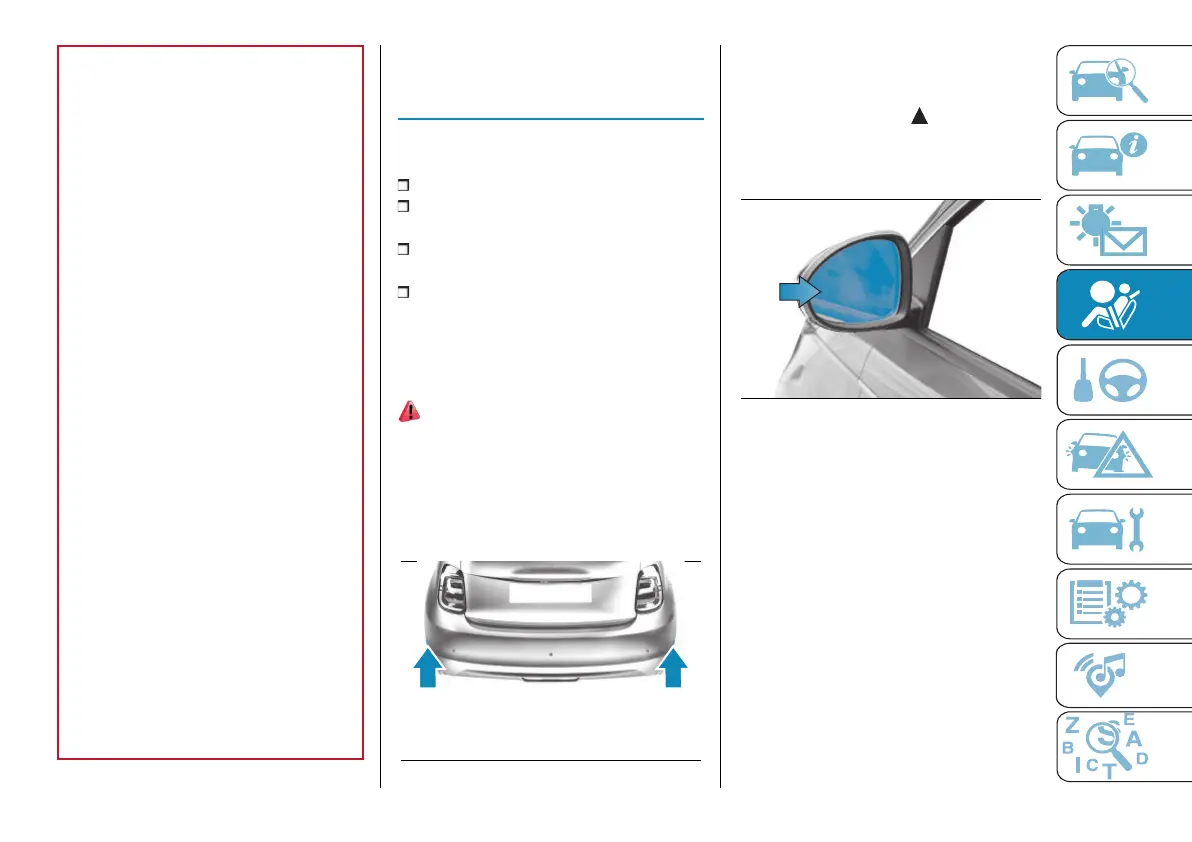
The Blind Spot Assist system uses
ultrasound sensors, located in the front
and rear bumpers (one for the rear side
- see fig. 98), to detect the presence of
cars in the rear side blind spots of the
car.
98 AB0A0526
The system warns the driver about
the presence of cars in the detection
area by lighting up, on the relevant
side, the warning light located on
the door mirror fig. 99, along with an
acoustic warning (see "Blind Spot Alert"
paragraph, "Sound & Display" mode).
99 F0S1142
Sensors
The sensors are activated when the
car is travelling at a speed greater than
approximately 15 km/h (9 mph) and
are temporarily deactivated at a speed
greater than approximately 140 km/h
(84 mph).
The detection area of the system
covers the blind spot of the rear-view
mirror. When the sensors are active the
system monitors the detection areas on
both sides of the car and warns the
driver about the possible presence of
cars in these areas.
While driving the system monitors the
detection area from three different input



 To Next Page