
 Need help?
Do you have a question about the Acteon X-MIND trium and is the answer not in the manual?
Important safety messages regarding operator, patient, and device safety.
Details on various labels affixed to the X-MIND Trium device for identification.
Visual guide showing the location of identification labels on the device.
Explanation of various symbols used in the manual and on the device.
Details on the workstation and its software modules for image acquisition and processing.
Description of the remote control for operating the X-ray emission.
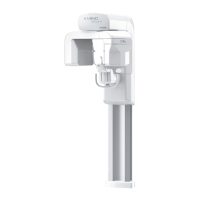
Identification and description of the main parts of the X-MIND Trium device.
Overview of different X-MIND Trium configurations like PAN only, PAN/CBCT, etc.
Lists the types of imaging exams that can be performed with the device.
Description of the physical control panels for device operation and patient positioning.
Detailed explanation of the function of each key on the control panels.
Explanation of the green, yellow, and red indicator lights and their meanings.
Information on patient and remote emergency switches for immediate device shutdown.
How to activate and manage the X-ray exposure using the dedicated switch.
Step-by-step guide on how to turn on the X-MIND Trium device and workstation.
Procedures for safely shutting down the X-MIND Trium device and workstation.
Essential steps to prepare the device before starting an imaging acquisition.
Guidelines for instructing and preparing the patient before the scan.
Detailed procedure for correctly positioning the patient for panoramic and CBCT scans.
Guide to choosing the correct exam type and loading factors for PAN imaging.
Specific steps for positioning the patient for optimal panoramic imaging.
Step-by-step process for performing the panoramic X-ray acquisition.
Guide to selecting CBCT exam type, FOV, and quality settings.
Detailed procedure for positioning the patient for CBCT scans using lasers.
Step-by-step process for performing the CBCT X-ray acquisition.
Guide to choosing CEPH exam types and loading factors.
Specific steps for positioning the patient for cephalometric imaging.
Step-by-step process for performing the cephalometric X-ray acquisition.
Guidelines for periodic checks, calibration, and quality control of the device.
Proper methods for cleaning and disinfecting the external surfaces of the device.
Instructions for the environmentally safe disposal of the medical device at its end of life.
Table of error codes, their descriptions, and recommended solutions and responsible parties.
Detailed list of specific error messages and troubleshooting steps for the X-MIND Trium.
Technical details regarding the device's power supply requirements and characteristics.
Information on the device's electrical safety classification and standards compliance.
Technical specifications of the X-ray assembly and the X-ray tube model used.
Dimensions, weight, and mechanical configuration details of the device.
Minimum hardware specifications for the computer workstation used with the device.
Details on the detector technology, manufacturer, model, and active area.
Specific scanning parameters for Panoramic and Cephalometric exams.
Specific scanning parameters for CBCT exams, including exposure time and quality settings.
Technical details of the lasers used for patient positioning, including wavelength and power.
Minimum requirements for the PC running the Acteon Imaging Suite client software.
Diagrams and measurements showing the physical size and operational movement range of the unit.
Detailed CTDI values for CBCT exams under various conditions and patient types.
Information on EMC standards and guidance for safe operation.
Guidance on immunity to electromagnetic disturbances and appropriate environments.
Guidelines for immunity to RF interference from handheld devices.
Specific US federal law regarding the sale and use of the device by professionals.
Criteria for who can operate the device, including training and qualifications.
Description of the age and physical characteristics of the target patient population.
Information on X-ray hazards and essential protection measures for patients and operators.
Critical safety guidelines related to electrical connections, grounding, and voltage.
Safety warnings regarding the use of positioning lasers and potential eye hazards.
Operator responsibilities for data storage, backup, and protection.
Potential interferences with other medical devices, especially pacemakers.
List of uses and environmental conditions that are prohibited for the device.
 General
| Focal spot size | 0.5 mm |
|---|---|
| Sensor Type | Digital |
| Power Supply | 230 V AC, 50/60 Hz |
| X-ray generator voltage | 60-70 kV |
| X-ray generator current | 7 mA |
| Total filtration | 2.5 mm Al equivalent |
| Compatibility | Compatible with imaging software |

 To Next Page
