
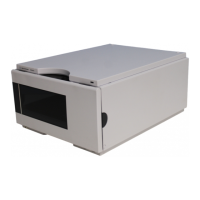
 Need help?
Do you have a question about the Agilent Technologies G1367A and is the answer not in the manual?
 General
| Brand | Agilent Technologies |
|---|---|
| Model | G1367A |
| Category | Laboratory Equipment |
| Language | English |
Ensuring an optimal site environment for autosampler performance.
Procedure for inspecting and unpacking the autosampler upon receipt.
Recommended system configuration for optimum performance and minimum delay volume.
Step-by-step instructions for the installation of the autosampler.
Specific installation steps for the thermostatted version of the sampler.
Detailed guide on establishing the necessary flow connections for the sampler.
Information regarding the installation and use of sample trays.
A list of recommended plates and closing mats for the sampler.
Recommendations for suitable vials and caps for use with the sampler.
Procedure for configuring custom well-plate types not listed.
Guidelines and precautions for transporting the autosampler.
General guidance on optimizing autosampler parameters for improved results.
Techniques and procedures to achieve the lowest possible carry-over.
Strategies for reducing injection cycle times and system delay volume.
Methods to ensure accuracy and precision in injection volumes.
Information on selecting the appropriate rotor seal material.
Guidance on selecting the correct seat capillary for specific applications.
Explanation of status indicators, error messages, and available test functions.
Description of the instrument's status indicators and their meanings.
List and explanation of common error messages and their causes.
Functions designed to facilitate easier access for maintenance operations.
Procedure for performing automatic alignment of the sample transport.
Commands for manual control of sampling sequence steps for troubleshooting.
Specific guidance for troubleshooting issues with the G1367A sampler.
Detailed steps for turning on and initializing the instrument.
Classification of logbook errors and step-by-step repair procedures.
Procedure for ensuring correct needle positioning over vials or wells.
General overview and introduction to the sampler repair procedures.
Visual identification of the main assemblies for repair.
Procedures for common repairs that can be done with the sampler in place.
Procedures for replacing internal components requiring disassembly.
Detailed breakdown and part numbers for the main sampler assemblies.
Components and part numbers for the sampling unit.
Details and part numbers for the analytical head assembly.
Components and part numbers for the injection valve assembly.
Contents of the well-plate and micro well-plate sampler accessory kits.
Summary of available cables and their specifications.
General overview of the Agilent 1100 Series well-plate sampler models.
Step-by-step description of the sampler's operation during a sampling sequence.
Detailed explanation of the sampling unit's functional elements.
Description of the needle and sample transport mechanism and its axes.
Explanation of optional operating modes like multi-draw and overlapped injection.
Description of the Early Maintenance Feedback feature and its counters.
Overview of the electrical interfaces and connection types.
Explanation of the electronics and processor controlling the autosampler.
Details on the sensors used for detecting component positions and movements.
Description of the Microtiter Plate Board's common electronics and ASIC.
Details on the instrument's firmware structure and update mechanisms.
Information on optional interface boards like BCD and LAN.
Overview of the communication interfaces supported by Agilent 1100 modules.
Instructions for configuring parameters using the 8-bit switch.
Description and specifications of the instrument's main power supply unit.
Explanation of the primary keys and their functions on the control module.
Description of the various screens accessible from the Analysis view.
Description of the screens available in the System view.
Detailed performance specifications for the Agilent 1100 Series Well Plate Sampler.
Essential safety precautions to be observed during operation, service, and repair.


 To Next Page