4 FEATURES
4.1 SIP Paging: Registering an 8301 Device
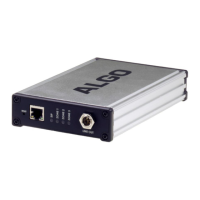
The 8301 Paging Adapter & Scheduler can be registered as a 3
rd
-party SIP extension with a hosted or enterprise
Communications Server supporting 3
rd
-party SIP endpoints.
To register the adapter with the SIP server, use the Basic Settings → SIP tab in the web interface to enter the
Communication Server IP address/domain name, extension, username, and password. This information will be
available from the IT Administrator.
If VLANs are used, navigate to the Advanced Settings → Network tab to set VLAN options. (Note, once the adapter is
using VLAN you will need to be on the same VLAN to access the web interface.)
The adapter may now be accessed by dialing its assigned extension from a telephone, device, or client. The adapter
will auto-answer, play the default pre-announce tone, and allow voice paging until disconnected.
There are several configurable adapter options, such as:
• Increase or Decrease Volume
• Enable AGC (automatic gain control)
• Ambient noise compensation
• Customize pre-announce tone file
• Passcode protection
The best voice paging quality and intelligibility will be obtained using the G.722 wideband audio codec. Most current
IP telephones support G.722 which is sometimes referred to as “HD” voice or audio.
4.2 SIP Paging: Multiple Algo SIP Endpoints (Using Multicast)
Multicast features in the 8301 Paging Adapter & Scheduler require that only the first adapter be registered as a SIP
extension. Additional Algo IP endpoints, including any combination of paging adapters, speakers, and visual alerters,
may be added as multicast Receivers receiving a stream from the SIP registered Transmitter adapter, provided that
only a single audio stream will be active at any given time across any or all of the devices. If multiple unique audio
streams are needed simultaneously more than one Transmitter device will be required.
The adapter configured as the transmitter will simultaneously stream audio to the Receiver adapters. The Receiver
adapters do not require SIP extensions and do not need to register with the SIP Communication Server.
To enable multicast streaming from the Transmitter adapter, go to the web interface and navigate to the Basic
Settings → Multicast tab. Choose multicast mode ‘Transmitter (Sender)’ and pick ‘All Call’ for the Transmitter single
zone.
To enable multicast monitoring in the Receiver endpoints, go to the web interface for each endpoint and navigate to
the Basic Settings → Multicast tab. This time though, choose multicast mode ‘Receiver (Listener)’. There is no need to
select a zone as the endpoint will monitor the ‘All Call’ zone IP address by default.


 To Next Page