1 GENERAL
1.1 Introduction
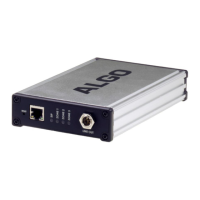
Algo’s 8301 IP Paging Adapter & Scheduler is a SIP-compliant, multicast-capable endpoint device for integrating
consumer, commercial, and professional audio amplifiers into an IP-based Unified Communication (UC) environment
for voice paging and notification. Emulating a page port similar to what is found on legacy PBX or key systems, the
8301 connects directly to traditional analog amplifiers, offering a simple and easy interface to a VoIP phone system.
The 8301 uses a balanced and isolated line level output that reduces hum and which can connect with any amplifier
with an input impedance between 600 Ohm to 10 kOhm.
The 8301 also includes a scheduler, synchronized to NTP, to provide scheduled bells, tones, and customer service or
emergency announcements for schools, retail shops, manufacturing facilities, and healthcare institutions. 1 GB of
memory is available in the device to store audio files, which can be played via the 8301 Line Out and, if desired, as a
multicast to other Algo speakers, paging adapters, and display speakers.
As a 3
rd
-party, SIP-compliant device, the 8301 is designed to seamlessly integrate into most leading IP-based UC and
Mass Notification platforms. The 8301 is easily configured using central provisioning features or by accessing the web
interface via a web browser.
The 8301 supports three types of extensions, page, ring, and emergency alerts. The different types of extensions are
assigned by entering the SIP credentials on the correct section in the configuration portal. Page extensions by nature
auto-answer and open a voice path, allowing for live announcements. Ring extensions don't answer the incoming call,
instead they play a configurable pre-recorded announcement. This is traditionally used as a loud ringer/night bell.
Lastly, emergency alert extensions are used to communicate critical situations. They use customizable pre-recorded
announcements and are generally configured to loop over the announcement until it is cancelled. These extensions
can be registered simultaneously but note that some systems limit devices to a single registration.
2 SETUP AND INSTALLATION


 To Next Page