6
5. VCO Circuit
A Colpitts oscillation circuit driven by Q131 directly oscillates the desired frequency.
The frequency control voltage determined in the CPU (IC1) and PLL circuit is
input to the varicaps (D122 and D123). This change the oscillation frequency,
which is amplified by the VCO buffer (Q134) and output from the VCO area.
6. VCO Shift Circuit
During transmission or the AIR band Reception (118~136 MHz), the VCO shift
circuit turns ON Q138, change control the capacitance of L123 and safely
oscillates the VCO by means of H signal from pin 16 of IC116.)
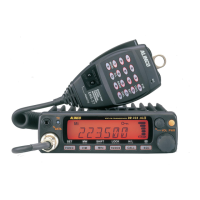
4) Receiver System (DR-235)
The receiver system is a double superheterodyne system with a 30.85 MHz first IF and a 455 kHz second IF.
1. Front End
The received signal at any frequency in the 216.000MHz to 279.995MHz range
is passed through the low-pass filter (L116, L115, L114, L113, C204, C203,
C202, C216 and C215) and tuning circuit (L105, L104 and D105, D104), and
amplified by the RF amplifier (Q107). The signal from Q107 is then passed
through the tuning circuit (L103, L107, L102, and varicaps D103, D107 and
D102) and converted into 30.85 MHz by the mixer (Q106). The tuning circuit,
which consists of L105, L104, varicaps D105 and D104, L103, L107, L102,
varicaps D103, D107 and D102, is controlled by the tracking voltage form the
VCO. The local signal from the VCO is passed through the buffer (Q112), and
supplied to the source of the mixer (Q106). The radio uses the lower side of the
superheterodyne system.
2. IF Circuit
The mixer mixes the received signal with the local signal to obtain the sum of
and difference between them. The crystal filter (XF102, XF101) selects 30.85
MHz frequency from the results and eliminates the signals of the unwanted
frequencies. The first IF amplifier (Q105) then amplifies the signal of the selected
frequency.
3. Demodulator Circuit
After the signal is amplified by the first IF amplifier (Q105), it is input to pin 24 of
the demodulator IC (IC108). The second local signal of 30.395 MHz, which is
oscillated by the internal oscillation circuit in IC108 and crystal (X104), is input
through pin 1 of IC108. Then, these two signals are mixed by the internal mixer
in IC108 and the result is converted into the second IF signal with a frequency
of 455 kHz. The second IF signal is output from pin 3 of IC108 to the ceramic
filter (FL101 or FL102), where the unwanted frequency band of that signal is
eliminated, and the resulting signal is sent back to the IC108 through pins 5.
The second IF signal input via pin 5 is demodulated by the internal limiter
amplifier and quadrature detection circuit in IC108, and output as an audio
signal through pin 12.



 To Next Page