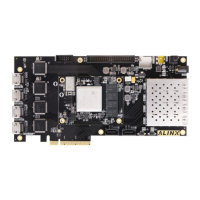
KINTEX UltraScale+ FPGA Board AXKU040 User Manual
Part 11: SD Card Slot
The SD card (Secure Digital Memory Card) is a memory card
based on the semiconductor flash memory process. It was
completed in 1999 by the Japanese Panasonic-led concept, and the
participants Toshiba and SanDisk of the United States conducted
substantial research and development. In 2000, these companies
launched the SD Association (Secure Digital Association), which has
a strong lineup and attracted a large number of vendors. These
include IBM, Microsoft, Motorola, NEC, Samsung, and others.
Driven by these leading manufacturers, SD cards have become the
most widely used memory card in consumer digital devices.
The AXKU040 FPGA development board includes a Micro SD
card interface to provide users with access to SD card memory for
storing pictures, music or other user data files.
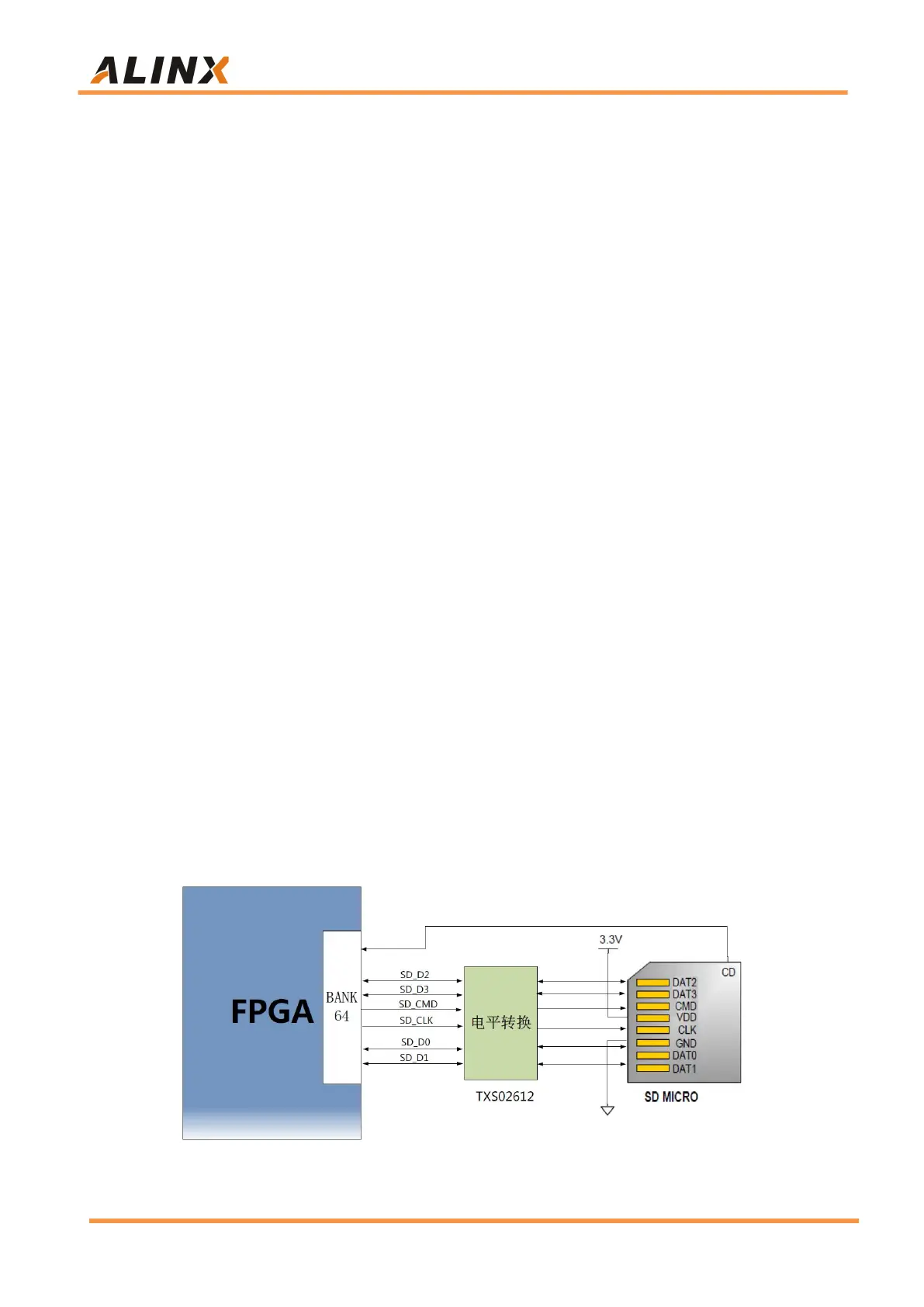
The IO signal is connected to the IO signal of the FPGA
BANK64, because the VCCIO of the BANK is FMC2_VADJ, the
default is +1.8V. However, the SD card has a data level of 3.3 and
needs to be connected via the TXS02612 level shifter. The
schematic diagram of the FPGA and SD card connector is shown in
Figure 11-1.
Figure 11-1: SD Card Slot Schematic



 To Next Page