Copyright © 2019 ANK Audio Kits
www.AudioNoteKits.com
audionotekits@rogers.com
Page 8
1.2 Basic Operation of the Amplifier
1.2.1 Overview
ANK Audio Kits is pleased to announce the new Mentor SET Power Amplifier. As anyone who has ever
heard the transcendent musicality of a single-ended amplifier will tell you, there is something very
special about the music that flows from (relatively) simple, classic Class A triode circuits. Perhaps
it's the absence of crossover distortion, perhaps it's the gorgeous midband reproduction, perhaps it's
the zero-feedback design, perhaps it's the organic (even desirable) expressiveness of the second
harmonic; more likely it's all of this and more.
ANK Audio Kits and SET amplifiers go a long way back — right to the beginning in fact, with our Kit1
300B, which has had successive and very successful anniversary editions. Our single or parallel
300B or 2A3 Legend monoblocks are much sought after and the ultimate variant, our SET 300B
Interstage C-Core monoblocks, is simply awesome!
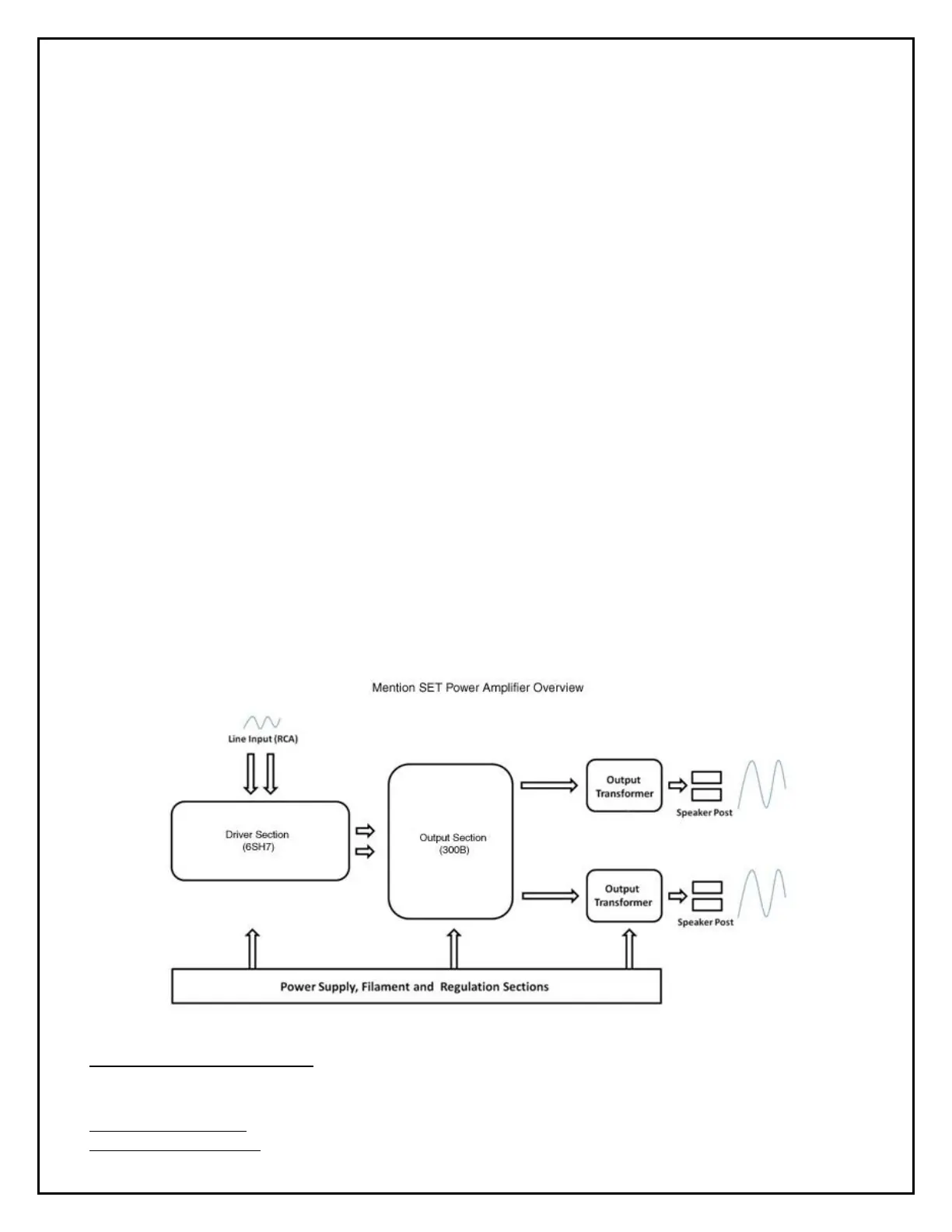
The Mentor SET Power Amplifier's Power Supply uses the classic 5U4G(B) rectifier tube, a high
quality Mundorf capacitor to smooth the AC power, DC 300B filaments, and a substantial Choke to
supply clean, high quality DC power to the circuitry while assuring dead quiet operation. The 2 6SH7
driver tubes, selected by Andy Grove, Audio Note (UK)'s Senior Design and R&D Engineer, for reasons
related to input impedance and power amplifier sensitivity, are wired in a pentode configuration to
drive the 300B or 2A3 triodes, which in turn produce either 8.5W or 3.5W per channel respectively
driving the EI-Core or quad C-Core output transformers. In our experience, even 3.5W is usually
plenty of power for most listening, especially with higher efficiency speakers.
1
1
We recommend a minimum of 88db speaker sensitivity.


 To Next Page