22
500 Series
Tipping load
Tipping load is the load at which the rear tires lose contact
with the ground (tipping forward). Tipping load is inuenced
by several factors:
• The total load on the loader boom (attachment weight
and load combined)
• The distance of the load from the front tires
• Straight or articulated position of the loader frame
• Levelness of the ground
• Installed counterweights
• Driver presence
• Movements of the loader and the load
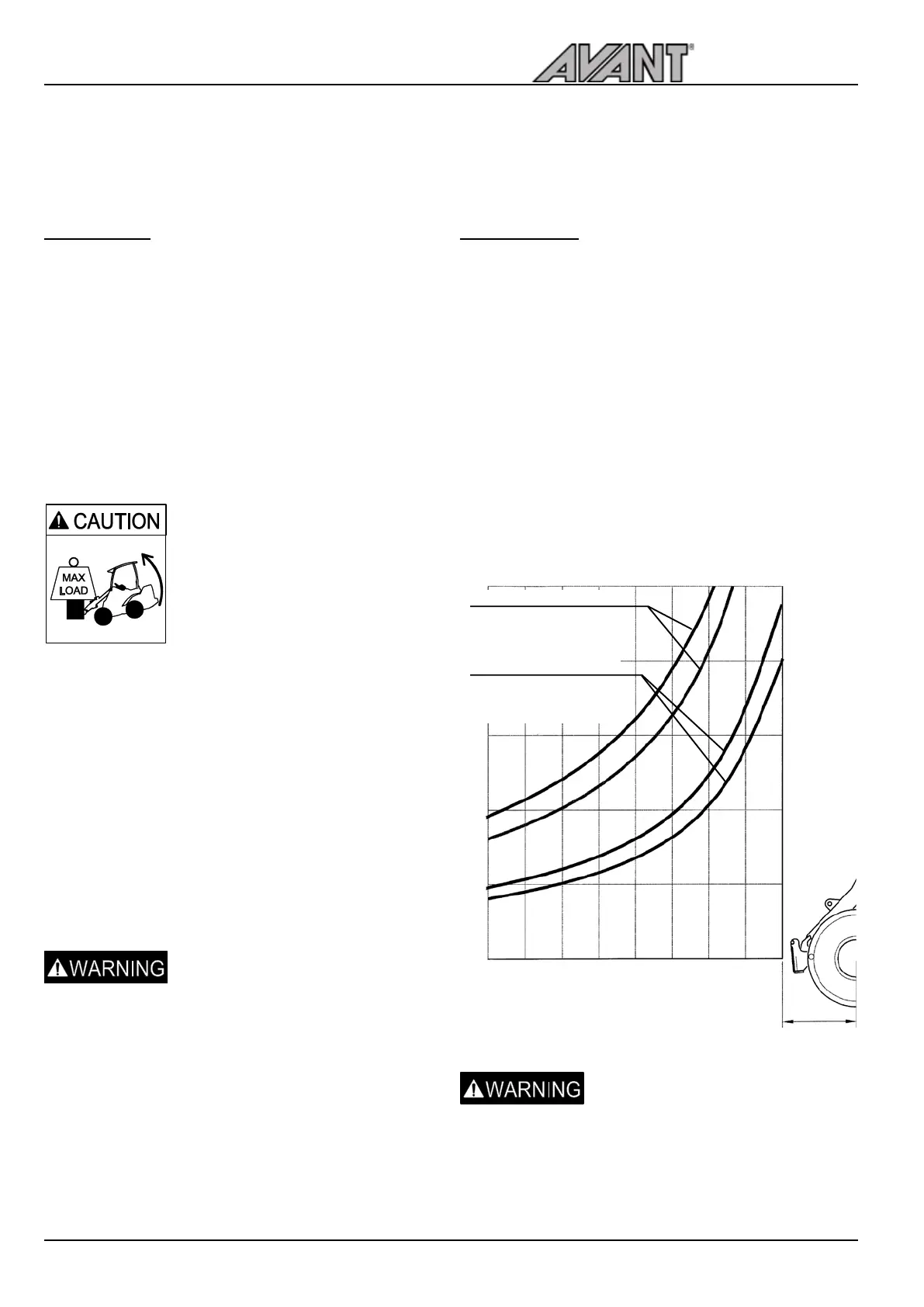
Overload will cause the loader to
tip forward. Always pay attention to
safe conditions operating whenever
loads or heavy attachments.
The lifting capacity and the stability of the loader are at the
best, when:
• the loader frame is kept straight
• the centre of gravity of the load is as close to the loader
as possible
• counterweights are tted to the loader
• swinging of the load is prevented and all controls are
used in a calm and careful manner
Example: If the centre of gravity of the load is 33.1 in
in front of the front axle (15.7 in from the pallet forks at
ground level), the tipping load is about 860 lb with a driver
weighting 165 lb and with the articulated frame turned to
max articulation.
If you leave the loader, tipping
and max. loads are reduced
respectively. The indicated load
is the maximum load that can be
loaded on pallet forks and the
machine will not tip over, i.e. the
weight of the standard pallet fork
attachment (210 lb (90 kg)) is
taken into account.
Load diagram
You can evaluate the load handling capability of the
loader with the load diagram, shown below, and the Rated
operating capacity shown on the next page and on the
label on the loader.The load handling capability depends
on the distance between the centre of gravity of the load
and the front axle of the loader.The diagram represents
the forward stability only, it does not refer to maximum
available lift force.
The load diagram below shows the tipping loads on a level
surface:
a) Tipping load with the loader frame in straight position.
b) Tipping load with the loader frame in maximum
articulation.
• ROC (Rate operating capacity), dened as 60 % of
tipping load for pallet forks.
Avoid overloading the loader
- know the load and lifting
capacity of the loader. The
diagram is valid only on rm and
level ground, with the conditions
listed above.
Tipping load with the loader
In max. articulation
Rear weight 375 lb (170 kg)
Driver 165 lb (75 kg)
Distance from front axle in inches
Rated operating capacity (ROC)
The loader In max. articulation
Rear weight 375 lb (170 kg)
Driver 165 lb (75 kg)
528 520
528
520
98.4 88.6 78.7 68.9 59.0 49.2 39.4 29.5 19.7
19.7
2750 lb
2200 lb
1650 lb
1100 lb
550 lb
Tipping load
Tipping load


 To Next Page