6
500 SeriesSafety instructions
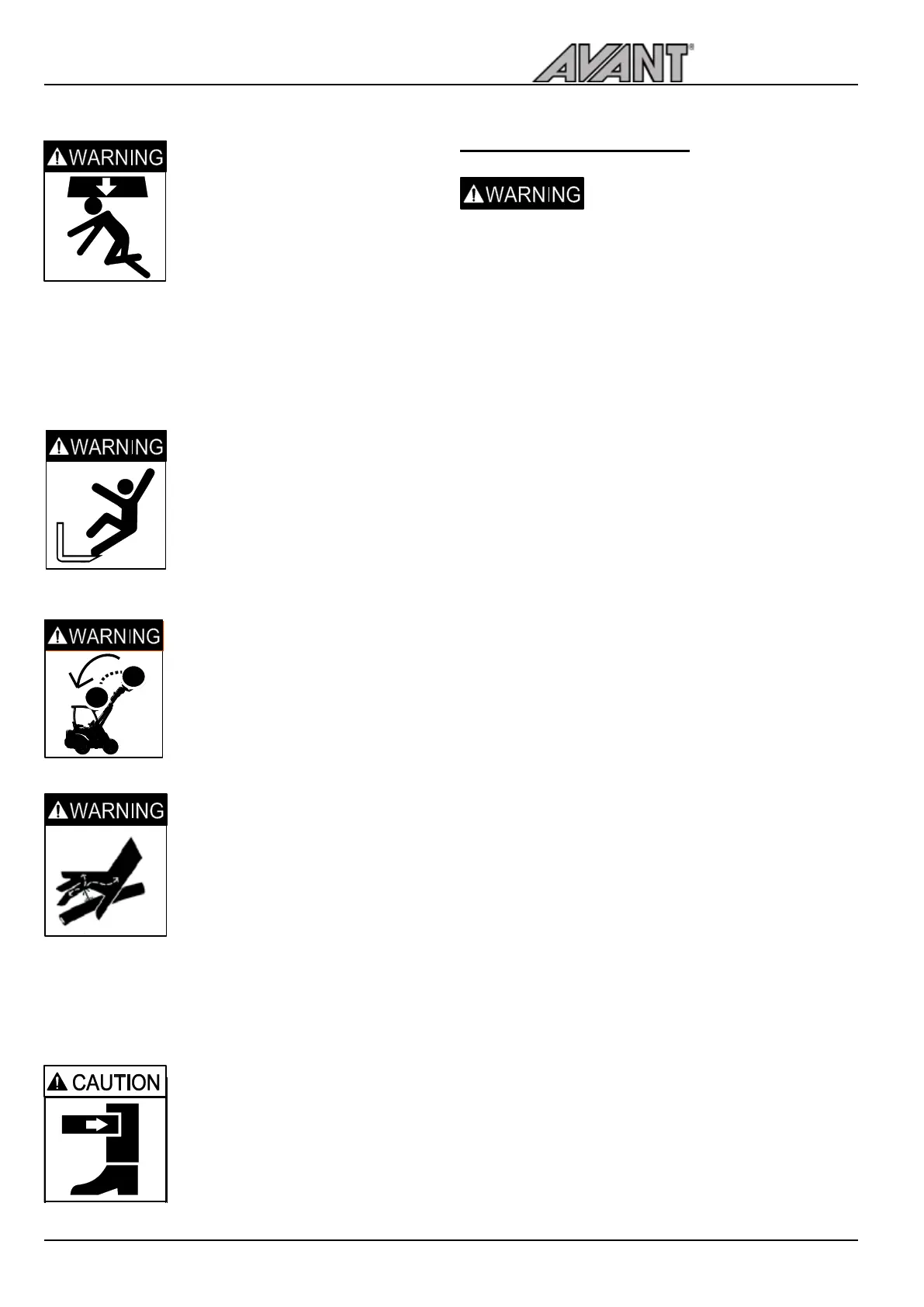
Falling of load or unexpected
lowering of loader boom - Risk of
crushing. Always remember that the
boom may lower unexpectedly due to
loss of stability, mechanical fault, or if
another person operates the controls
of the loader, leading to crushing
hazard. The attachment or the loader
are not intended to be left to keep
a load elevated for longer periods.
Lower the attachment before leaving
the driver’s seat. The stability of the
loader may change when leaving the
driver’s seat, leading to tipping over
of the machine.
Falling of persons - Risk of
crushing. Never use the loader or
its attachments to lift persons or
as any kind of work platform even
temporarily. Never climb on the
loader or on the attachment. Seating
capacity: one person only, regardless
of attachment.
Risk of falling objects - Make sure
load is securely on the attachment.
Never tilt the attachment back when
it is lifted high. Operate only with
machines equipped with ROPS and
FOPS structures. Make sure the
attachment is properly locked.
Hydraulic pressure - Risk of
injury. Escaping hydraulic uid
under pressure has sufcient force
to penetrate skin, causing serious
personal injury. Never use hands to
search for possible leaks in hydraulic
systems - use a piece of cardboard
instead. Release residual hydraulic
pressure before disconnecting
any tting and before any service
operation. See a doctor immediately
if hydraulic uid penetrates skin,
serious injury can result quickly,.
Pinch point.
Turning articulated frame may cause
contact with body. Do not grasp
steering wheel when entering or
leaving loader.
Handling of heavy loads
Handle loader with care - Risk of
tipping over.
• Follow all instructions and warning
labels to avoid tipping over of the
loader.
• Always put the load down on
the ground before you leave the
driver’s seat.
• Keep loads as low and as close to
the loader as possible.
• When loading, always keep
the loader frame as straight as
possible.
• Never take a heavy load on the
loader from high level – e.g. from
truck, shelf etc.
• Always handle heavy loads only on rm, level ground,
while you drive slowly with the machine.
- Uneven or inclined terrain signicantly reduces the
safe working load, (see also page 23.)
- Use the maximum loads indicated in the diagram in
this manual as a guideline.
- All rated operating capacities are based on the
criteria of the machine is level on a rm supporting
ground. When the machine is operated in conditions
that deviate from these criteria (e.g. on soft or uneven
ground, on a slope or when subject to slide loads),
you must take these conditions into account.
- Remember that the actual load carrying capacity
varies greatly according to operating conditions and
control manner.
• Keep the articulated frame of the loader in straight position
when you lift heavy loads. If you turn the loader during
load handling, the stability of the loader will decrease and
it may overturn the machine.
• The use of extra rear weights or ballasted tires is
recommended. See page 36 for different options.
• Make sure to follow the recommended tire pressures.
• Pay attention that a heavy load or long distance between
the loader and the center of gravity of the load will affect
the balance and handling of the loader.
• When you estimate the lifting capacity of the loader,
remember to take the weight of the attachment into
account.


 To Next Page