23
500 Series
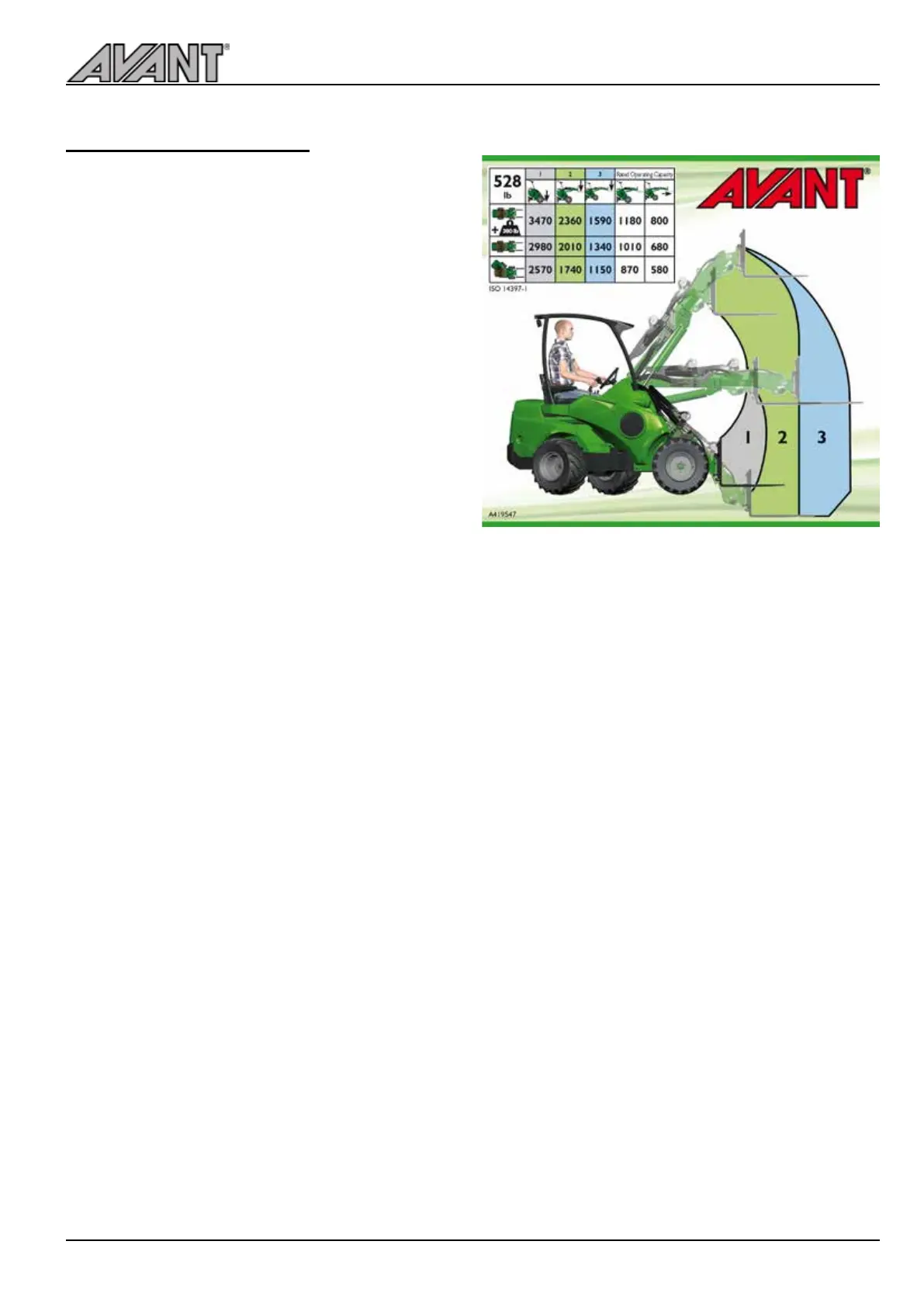
Rated operating capacity
To determine how much the loader can handle safely, a
table of the tipping load and a calculated Rated Operating
Capacity (ROC) is shown in the adjacent label.
A rated Operating capacity label is located near the driver’s
seat and can be read while you sit on the driver’s seat
Rated operating capacity depends on type of use of the
loader:
• In bucket and general application the rated operating
capacity is 50% of tipping load
• In pallet fork application the rated operating capacity is
60% of tipping load
The information shown in the table is the worst case
minimum load, with the conditions listed below. Actual lifting
capacity could be signicantly higher, or it may be lower,
depending on terrain conditions, available lifting force, and
load distribution. Adding or removing counterweights will
affect the indicated ROC.
The ROC table is valid, when:
• The ground is rm and level
• Loader is stationary or driven max 2 km/h, with smooth
and slow control movements
• Driver 165 lb (75 kg) is seated on the driver’s seat
• Load is distributed evenly on pallet forks, with the load
centre of gravity at 16” (400 mm) from the vertical part
of pallet fork arms. The weight of the fork attachment
is taken into account in the indicated load values
Rated operating capacity
Different loader congurations, rows in the label:
1. Loader frame in straight position, standard
counterweight tted
2. Loader frame in fully articulated position, standard
counterweight tted
Different positions of the loader boom, columns in the
label:
1. Maximum tipping load, stability when lifting load just
off the ground
2. Boom lifted to horizontal position (least stable
position)
3. Rated operating capacity in pallet fork application
Tipping load


 To Next Page