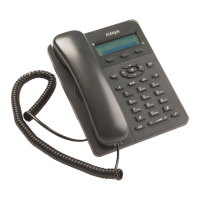
FIRMWARE VERSION 1.0.5.2 E129 SIP DESKPHONE USER MANUAL Page 18 of
60
Direct IP Call allows two phones to talk to each other in an ad-hoc fashion without a SIP proxy. VoIP calls
can be made between two phones if:
Both phones have public IP addresses; or
Both phones are on the same LAN/VPN using private or public IP addresses; or
Both phones can be connected through a router using public or private IP addresses (with necessary
port forwarding or DMZ).
To make a direct IP call, please follow the steps below:
Press MENU button to bring up main menu;
Select "Direct IP Call" using the navigation arrow keys;
Press MENU to enter the Direct IP Call mode;
Input the 12-digit target IP address (Please see example below);
Press the "More" softkey to make sure the softkey selection "IPv4" or "IPv6" is correctly selected
depending on your network environment;
Press "OK" softkey to dial.
For example:
If the target IP address is 192.168.1.60 and the port is 5062 (i.e., 192.168.1.60:5062), input the following:
192*168*1*60#5062. The * key represents the dot (.), the # key represents colon (:). Wait for about 4
seconds and the phone will initiate the call.
Quick IP Call Mode:
The E129 SIP DESKPHONE also supports Quick IP Call mode. This enables the phone to make direct IP
calls using only the last few digits (last octet) of the target phone's IP address. This is possible only if both
phones are under the same LAN/VPN. This simulates a PBX function using the CMSA/CD without a SIP
server. Controlled static IP usage is recommended.
To enable Quick IP Call Mode, go to E129 SIP DESKPHONE Web GUI->Advanced Setting page, set "Use
Quick IP Call Mode" to "Yes". Click on "Update" on the bottom of the Web GUI page to take the change. To
make Quick IP Call, take the phone off hook first. Then dial #xxx where x is 0-9 and xxx<255. Press # or
SEND and a direct IP call to aaa.bbb.ccc.XXX will be completed. "aaa.bbb.ccc" is from the local IP address
regardless of subnet mask. The number #xx or #x are also valid. The leading 0 is not required (but it's OK).
For example:
192.168.0.2 calling 192.168.0.3 -- dial #3 followed by # or “SEND”;




 To Next Page