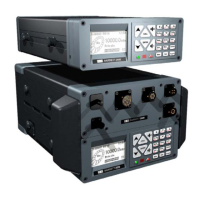
3.0 Overview
All 900 series transceivers and receivers are made up of several common building blocks. Apart from the
940 man-pack transceiver they are all constructed with a common chassis. This manual deals with each
module and has a separate section describing sections of transceivers and receivers that are unique
to that transceiver or receiver.
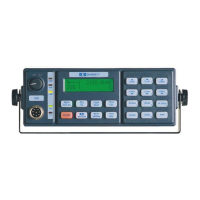
The 980/950/930/ local control transceivers are comprised of the following four modules:-
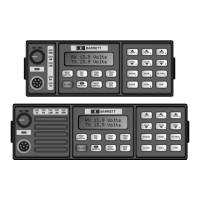
The 950/930 remote control transceivers are comprised of the following four modules:-
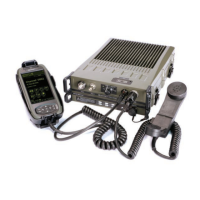
The 940 man-pack comprises the following six modules:-
The backlit keypad allows entry of channel number, transmit frequency, receive frequency, mode, Selcall,
power, scan, ATU option and customer specific information. A 2 line x 16 character backlit LCD display
annunciates the channel frequency and indicates which functions have been selected on this channel.
Numerous other status displays are optionally available. On the left hand side of the display 5 status LED's
indicate the current mode of the transceiver. A red LED is illuminated in transmit, a green LED in receive and
three yellow LED's indicate which of the three modes, USB, LSB or AM has been selected (J3E, H3E, F1B
on the 980 transceiver). A rotary volume control and on/off switch and a Mylar cone speaker are also
included on the front panel. The microphone which incorporates press to talk and channel up/down buttons,
plugs into an 8 pin socket on the front panel. Note:- The standard microphone has a jumper in it (refer to the
microphone diagrams) that enables the front panel speaker, the handset does not have this jumper thus
disabling the speaker.
The Microprocessor PCB is the central control of the transceiver. This PCB also contains the Direct Digital
Frequency Synthesis (DDFS) system which generates all local oscillator injection frequencies, the Selcall
demodulator and the audio syllabic mute sensing circuit.
The RF/Audio PCB contains the receiver and transmitter exciter, the audio processor section and general
interface to the outside of the transceiver. The receiver employs a double conversion superhet design with a
high dynamic range. All receiver signals are processed through either a single sideband filter which has a
passband of 2.4KHz or in the case of AFSK (J2B) signals, through a narrow sideband filter with a passband
of 500Hz. A product detector is used to demodulate all single sideband signals, whilst an envelope detector
is used to demodulate AM signals. An effective noise blanker, employing a separate pulse receiver, is
provided which may be switched on or off as required.
There is a great deal of commonality between receive and transmit paths in both the R.F. and audio circuits.
In transmit, audio from the microphone, the auxiliary input or the remote head is passed to an automatic level
control circuit which amplifies and maintains a constant modulating signal with considerable variations in
input signal level. This maintains an adequate modulation level in all circumstances.
On receive, the signal is amplified and fed to a mute circuit. Both receive and transmit audio share a
common path up to the volume control. The RS-232 computer interface is located on the RF/Audio PCB.
*Front Panel *Microprocessor PCB
*PA PCB *RF/Audio PCB
*Microprocessor PCB *PA PCB
*RF/Audio PCB Remote control head and interface cable
*Microprocessor PCB *PA PCB
*RF/Audio PCB *Front panel
*Connector transition PCB
*
3.1 Front Panel
3.2 Microprocessor PCB
3.3 RF/Audio PCB
BARRETT 900 SERIES TRANSCEIVERS
PAGE 11



 To Next Page