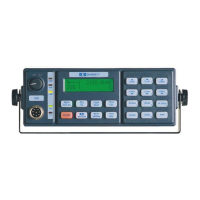
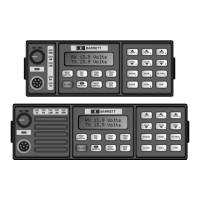
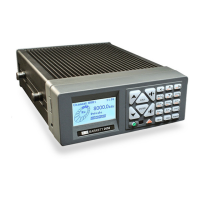
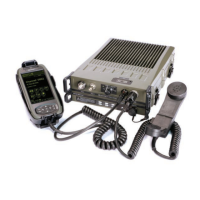
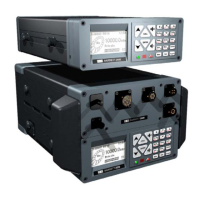
BARRETT 900 SERIES TRANSCEIVERS
The 45 MHz signal from the IF is converted to 455 kHz by the second mixer U13 which is a double balanced
ring mixer, and is fed with a +7 dBm oscillator signal at 45.455 MHz from the master oscillator on the
microprocessor PCB. T6 (and T4, if the narrow filter option is fitted) provides the necessary impedance
matching into the second IF ceramic filter F1 (second IF crystal filter F6, if the narrow filter option is fitted).
This filter gives the final selectivity for the system of 2.3 kHz@3dBand4kHz@60dB.(500 Hz @ 3 dB and
1 kHz @ 60 dB if the narrow option is fitted)
The noise blanker receiver is fed from the first mixer output via FET Q28 which acts as a buffer and prevents
the noise blanker receiver local oscillator generating intermodulation products in the main receiver. An FM
superheterodyne chip NE615D, U2 is used with wide ceramic filters F4, F5 to detect impulse noise. The
RSSI output on pin 7 produces a DC level which responds rapidly to noise. A comparator U9 with threshold
adjustment employs an integrator and differentiator on input pins 4 and 5 respectively so that noise blanking
occurs only on rapidly changing signals such as noise spikes.
The noise gate uses RF switch NE630, U12. This is a high speed switch that when enabled allows the
receive signal from the second mixer to pass directly to the 455 kHz filter. When a blanking pulse from the
noise blanker receiver is present the NE630 U12 switches the RF signal containing the noise pulse away
from the mixer thus blanking the noise pulse from further processing.
Following the noise blanker RF switch U12, RF switch U8, switches in the narrow or standard filter as
required. Following the filter(s) on receive, a transmission gate U7 routes the 455 kHz signal into the 455 kHz
IF amplifier consisting of U4 and transistors Q11 and Q13. U4 is a wide-band amplifier, the output being
applied to the base of Q11. The output in turn is further amplified by Q13 which is tuned to 455 kHz by T8. In
SSB modes the output of the 455 kHz IF amplifier is fed into the double-balanced mixer U6 which is the
product detector for receive, and the balanced modulator for generating the first I.F. on transmit. The double
balanced mixer is fed by the carrier insertion oscillator ,generated on the microprocessor PCB, which has
frequencies as follows 453.3 kHz for USB, 456.6 kHz for LSB, 453.00 kHz for CW and 456.56 kHz when the
500 Hz filter is in use. When receiving AM, the injection oscillator is switched off. The audio output from U6
pin 6 passes through a switch U14:B to the audio section described below. U14:B switches the output of AM
detector Q18 to the audio section, when AM is selected. The IF signal from Q13 is also fed into Q14 and U5
which comprise the AGC voltage generator. Q14 rectifies the IF signal to charge C53. The voltage on C53 is
thus proportional to the level of the received signal. This level is amplified by U5A to provide the final A G C
voltage for U4. This AGC voltage is also inverted and level shifted by U33:A, and is applied to the two 45
MHz IF amplifiers Q4 and Q5. These devices need to have AGC applied in the opposite sense to that
required by U4. Q13 also feeds the "S" meter rectifier Q10, which sends the DC proportional to signal
strength to the microprocessor board for processing and display.
Switching transistors Q8 and Q12 control the Tx/Rx relays and the noise blanker power supply.
The audio section handles the routing of audio signals in the transceiver and implements audio processing
and frequency tailoring. It also handles the extensive I/O with the outside world such as Auxiliary 600 input
and output (950 only), Computer Interface (950 only), ATU Interface and external alarm. Audio muting and
the Loudspeaker drive amplifier are also fitted on the PCB.
4.2.1.2 Second mixer and bandpass crystal filter.
4.2.1.3 Noise blanker
4.2.1.4 Noise gate
4.2.1.5 Second IF, AGC and demodulator
4.2.1.6 Transmit and receive switching
4.2.2 Audio section
PAGE 21



 To Next Page