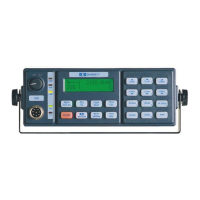
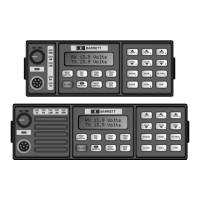
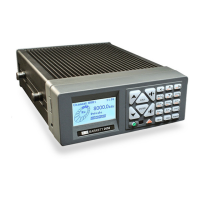
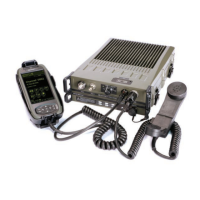
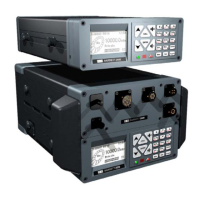
BARRETT 900 SERIES TRANSCEIVERS
A number of Complementary Metal Oxide Semiconductor (CMOS) devices are used in the transceiver and
most of them have built-in protection. However, their extremely high open-circuit impedance makes them
susceptible to damage from static charges. Care must be used when handling these devices during
servicing. By observing the following precautions, the risk of damage to CMOS devices will be minimised:-
Replacement CMOS devices are supplied in special conductive packaging. They should remain in this
packaging until required for use.
Ensure that power supplies are switched off before making connection or disconnections between circuit
boards.
Handle circuit boards and touch conductive parts as little as possible.
Anything connected to or touching the circuit board tracks should be grounded.
Make sure test equipment being used has a correct earth on its mains lead.
Before and during work on PCB's or handling CMOS devices, discharge static charges, which may build up
on a person, by touching a grounded metal surface with both hands. If possible wear a suitably grounded
conductive wrist strap.
When making measurements of the low level stages of the exciter, it is advisable to remove the drive to the
PA and Filter PCB, this can be achieved by removing the coaxial cable from the RF/Audio PCB to the PA
PCB by carefully unsoldering it. If working on the whole system with the power amplifier connected, caution
should be exercised when connecting probes in the area of the MC1350 gain controlled amplifier as a probe
can cause instability which can drive the power amplifier to full power without ALC action being available
resulting in damage to the power amplifier. When connecting probes to the PA assembly, the earth clip lead
should be wound around the body of the probe and the earth clip should be connected to the ground plane,
adjacent to the point of measurement to which the probe tip is connected, thus reducing any stray RF pick-
up.
Removing the top cover gives access to the microprocessor PCB.
Removing the bottom covers gives access to the RF/Audio PCB and PA PCB. The RF/Audio PCB is
mounted under a separate RF shield plate held in place with two screws and a slot behind the front panel.
Referring to figure 940 chassis explosion diagram remove the battery pack from the transceiver, remove the
six hex head screws from the rear of the transceiver, carefully remove the back plate to the extent the power
cable will enable then rotate and slide the aluminum extruded cover by sliding it upwards, allowing the back
plate to pass through the centre of the cover extrusion.
Remove the two screws on the rear panel of the remote control head allowing the front panel and rear shell to
be separated.
5.4 CMOS devices
5.5 Transmitter power amplifier maintenance precautions
5.6 PCB access
5.6.1 930 - 950 - 980 transceivers
5.6.2 940 transceivers
5.6.3 930 - 950 remote control head
PAGE 31



 To Next Page