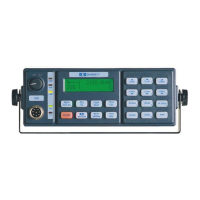
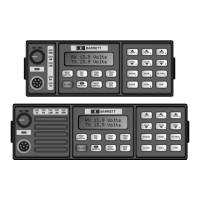
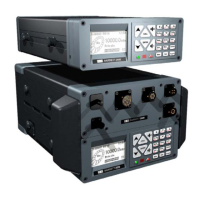
BARRETT 900 SERIES TRANSCEIVERS
5.7.3 Transceiver will not receive but displays OK
5.7.3.1 No receiver noise at all
5.7.3.2 Receive noise present, but does not receive
5.7.3.4 Transceiver turns on but displays "Barrett 900 Transceiver" only
It is assumed in this section that, the transceiver turns on and displays are normal.
If using a remote control head check the speaker is plugged in.
- Check that the audio mute, selcall mute or signal strength mute is switched off
- Check the audio path from the product detector
- Ensure jumper J1 on the RF/Audio PCB is in place, no receiver audio will be heard if it is not.
- With the volume control at full and mute off, and USB mode selected, inject a reasonably high level
audio signal starting at TP17, on the output of the product detector, and progress up the audio chain
via J1, TP24, TP21 in the case of the local control front panel and TP13 in the case of the remote
control head, eliminating sections of the audio path as you go. If the audio signal could be heard at
TP17 then the fault lies further back in the receiver and you should proceed to the section 5.7.3.2 -
"Receiver noise present but no receive".
- The next steps assume audio injection can be heard back to TP17, as in section 5.7.3.3.
- Set mode to upper or lower sideband.
- Check that the carrier injection oscillator is present on the coax from the microprocessor PCB going
to U6 pin 8 via C74 and R71. It should have a frequency of approx. 453kHz and a level of 1V P-P. If
not present or correct go to section 5.7.3.6 - VCO faults.
- Check the second local oscillator LO2 is present on pin 2 of the second mixer U13. It should have
a frequency of 45.455MHz and a level of approx.1.4V P-P (+7dBm). If not present or correct go to
section 5.7.6 - VCO faults.
- Check the first local oscillator LO1, generated by a phase locked loop on the microprocessor
PCB, is "locked", indicated by the red LED on the microprocessor PCB being extinguished (off).
Then with a channel frequency programmed to 2.000 MHz the frequency if the LO1 should be
47.455MHz (SCF + 45.455MHz) with a level of approx 2.8V P-P (+13dBm). If the VCO is unlocked
or the LO1 is not present or correct go to section 5.7.6 - VCO faults.
- Check the receiver AGC voltage on TP31 is 3.8V under no signal condition. If not investigate
the AGC generator and all supply voltages in the area.
- Now inject signals of correct frequency and levels as per the tables on the relevant RF/Audio PCB
schematics moving back up the receiver path towards the antenna progressively eliminating check
points and eventually locating the faulty section.
.
- On power on the front panel LCD display or remote head LCD display will initially show a
banner "Barrett 900 Transceiver" and the RX and AM LEDs will be lit. This is generated, as a
power on message, by the front panel and remote head micro, before the main microprocessor in
the transceiver starts communicating with it. When the main microprocessor communicates with the
front panel or remote head the display will change to the current channel and the LED's will indicate
the channel mode.
- If the front panel or remote head remains displaying only the banner "Barrett 900 transceiver, and
does not progress to the channel information, either the main microprocessor is inactive, in which
case refer to the section on main microprocessor faults, or the path carrying the serial data from the
microprocessor to the front panel is faulty. The serial signal that updates the front panel and remote
head displays is SD out. On the RF/Audio PCB this becomes SER DISP. SER DISP is split into two
signals by two inverters U25 D and U25 E becoming FP SD for the front panel and RH SD for the
remote head.
-
PAGE 35



 To Next Page