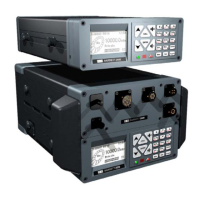
BARRETT 900 SERIES TRANSCEIVERS
5.7.6 VCO faults
5.7.7 Transmitter faulty
- If the transceiver beeps satisfactorily, the status LED's are correct and receiver noise is present but
the display indicates HARDWARE FAILURE VCO LOCK LOST, then there is a problem with the
frequency synthesiser. The red LED on the microprocessor should be illuminated under these
circumstances. Select a channel in the range 8 - 20MHz.
- To localise the PLL failure carry out the following checks: Check for square wave at TP22. If this is
present then the DDFS, DAC, LPF and buffer can be assumed to be operating. If there is no square
wave then work back through TP21 and TP20 with reference to the schematic waveforms until the
problem is located. Absence of a sine wave at TP21 probably indicates a DAC or QUALCOMM chip
fault. The DACs U8 and U9 have very short pins and should be checked for connection faults.
- Next check for a square wave at TP28. If this is present then the VCO, LPF, buffer and ÷10 pre-
scaler are probably functioning. If no square wave is present then check TP39. This should be
high, otherwise the pre-scalar is held in reset. Check for large swing of RF at pin 8 of U21:C. If this
is not present then check TP36 to ensure that 3V P-P RF is being generated by the VCO.
- If square waves are evident at TP22 and TP28 and the PLL is not in lock then the square waves will
be at different frequencies. Check the DC level at TP26. If this level is low (0V) then there is
possibly a fault with the charge pump transistors Q4, Q5 BFT92 whereas if the level is high (10V)
then Q2, Q3 BFR92 should be checked.
- When the VCO is in lock and the red LED is extinguished and the channel frequency is above 8MHz
then the two green LED's on the Microprocessor PCB should be illuminated. These indicate that the
VCO is delivering the correct RF level.
If the transceiver will not transmit, it is first necessary to determine which of the modules is at fault.
First disconnect the coaxial cable between the RF/Audio PCB output and the PA PCB input. Do this
at the RF/audio PCB end. Connect a coaxial cable from the RF/Audio PCB output to an
oscilloscope. Terminate the oscilloscope input in 50 ohms. Set the transceiver frequency to 10 MHz.
Either inject a two-tone test signal into the mic socket or whistle into the mic with the PTT activated.
A signal of approx. 35 mV P-P should be observed. If this signal is absent or very low then the fault is
likely to lie in the RF/Audio PCB, if not, re-connect the cable between the two PCBs.
Now check the two fuse links LK1 and LK2 on the PA. If either have blown, then investigate the
possibility of driver or PA transistor failure before reconnecting the power. If it is not these transistors
then a relay fault could exist in the output filter circuit this causing high collector current in the PA
transistors, due to the ALC being disabled in this condition, and as a result of the load mismatch
caused by the faulty relays.
If the fuse links are intact, measure the bias voltage at the bases of the driver and PA transistors with
PTT activated but with no two tone or speech input. The voltage should be between 0.5V and 0.7V. If
correct then check the DC voltage on the driver and PA collectors. These should be between 12V
and 14V. If these voltages are within limits, then it is likely that the driver or PA transistors are faulty.
Again inject a two tone signal or whistle into the microphone with the PTT activated and observe the
RF voltage on the driver transistor collectors (Q3, Q4). The swing should be at least 3V P-P. If
correct then the fault is likely to be in the final power amplifier stage. If no voltage swing was
observed on the driver collectors then check the driver base voltage swing, this should be
approximately 1V P-P using a two tone input or a whistle into the microphone. If this is not correct
then the fault could be the driver transistors, or in U1, Q1, or Q2.
PAGE 37



 To Next Page