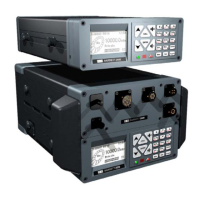
BARRETT 900 SERIES TRANSCEIVERS
4.2 RF / Audio PCB
The RF section of the RF / Audio PCB provides the complete exciter and receiver for the transceiver. It
includes:-
First mixer Roofing filter at 45 MHz
45 MHz IF amplifier with AGC 45 MHz Noise blanker receiver
Second mixer Noise blanker gate
SSB filter and narrow filter for AFSK Envelope detector for AM
Product detector for SSB,FSK and CW signals AGC detector
The RF section has a common RF input and output port and separate audio input for Tx and output for Rx. A
double superheterodyne system is used, with a first IF of 45MHz and second IF at 455 kHz. Three oscillator
injection frequencies are taken from the synthesiser, LO1 at (Carrier frequency + 45 MHz), LO2 at 45.455
MHz and LO3 or the Carrier Insertion Oscillator at 453.3kHz on USB and 456.6kHz on LSB. There is a
separate 45 MHz receiver to generate gating pulses for the noise blanker.
The audio section of the RF/Audio PCB handles the routing of audio signals in the transceiver and
implements audio processing and frequency tailoring. It also handles the extensive I/O with the outside
world such as Auxiliary 600 input and output (950, 980 only), computer Interface (950,980 only), ATU
Interface and external alarm. The audio power amplifiers for both the local and remote head speaker
outputs are also fitted on the RF/Audio PCB.
The 30 MHz low pass filter, L16, L20 and associated capacitors, minimises the image response of the
receiver. It also serves to control LO1 breakthrough on both Rx and Tx. The first mixer U29 and post mixer
amplifier Q1 is switched as a block between receive and transmit by relay RL1. The local oscillator level for
this mixer is +13dBm. The amplifier achieves the best possible broadband termination for the mixer IF port,
important to maintain low intermodulation distortion. The post mixer amplifier then feeds into the noise
blanker receiver via an isolation amplifier Q28, and also into the main receiver IF section via a dual section
45 MHz roofing filter giving medium selectivity of approximately +/- 3 kHz @ -3dB and +/-25 kHz @ 60dB.
The roofing filter feeds or is fed by the dual gate FET 45 MHz IF amplifier consisting of Q4 and Q5. The input
of this IF amplifier is matched to 50 by L1 and C21. The output is matched to 50 by the L network L9, C37.
AGC is applied to the 45 MHz IF amplifier via the second gates on Q4 and Q5. RL2 and RL3 control the Tx/Rx
turn around of this IF amplifier.
In transmit the 45MHz IF amplifier is reversed in its direction by relay RL2 and RL3, the output from the
second mixer is amplified by this 45MHz amplifier which in the transmit direction is gain controlled by a
voltage switched in place of the AGC signal. This voltage is adjusted by VR2 which sets the drive of the
exciter. The output of the 45MHz IF amplifier is then passed through the 45MHz roofing filter consisting of F2
and F2A and into the first mixer U29 and its associated post mixer pad and amplifier. The whole mixer, pad
and amplifier is reversed in the direction used in receive by relay RL1. The output of the mixer is fed into low
pass filter consisting of L16, L20 and associated capacitors.
4.2.1 RF section
4.2.1.1 30 MHz Low pass filter, first mixer and 45 MHz IF amplifier.
Receive
Transmit
PAGE 19



 To Next Page