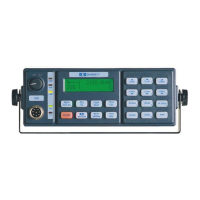
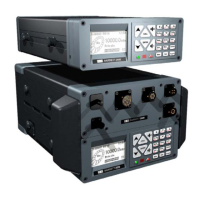
BARRETT 900 SERIES TRANSCEIVERS
5.8.3.3 IF Inductors
5.8.3.4 Noise blanker potentiometer
5.8.3.5 Carrier rejection potentiometer
Note :- If this method is used whilst the transmitter will
operate normally, the transmitter carrier rejection level may not meet specifications.
5.8.3.6 Transmit drive level set potentiometer
5.8.3.7 455Khz IF
5.8.4 PA PCB
5.8.4.1 Driver bias setup
5.8.4.2 PA bias setup
Inductors L5 and L9 can be peaked on a weak signal. As there is a very slight interaction they should be re-
peaked after initial setting. Leave L1 alone as this is part of the matching network from the crystal filter to the
45 MHz IF amplifier. L1 may be adjusted after the 45 MHz crystal filter has been adjusted as in paragraph
5.8.3.2 by reconnecting SP2, and transferring the spectrum analyzer input to TP4. Set the tracking
generator output level to -60 dBm. Adjust L1 for flattest response. Reverse the spectrum analyzer and
tracking generator connections, then go to Transmit by activating PTT with a microphone, and adjust L9 if
necessary for flattest response. This should only need a very slight adjustment if any at all. This adjusts the
input impedance of the crystal filter in the transmit direction.
VR1 should be set so that the voltage on the wiper of VR1 with a 1M ohm or greater input impedance meter
or a CRO is 0.8V.
The transceiver should be terminated in a 50 ohm, 30dB coaxial attenuator, capable of 100W PEP input, a
spectrum analyser should be connected to the output. Program a channel with a frequency of 10MHz .The
spectrum analyser centre frequency should be set to 10MHz with a span of 20KHz. VR4 should be adjusted
to obtain a minimum carrier output level when transmitting in SSB mode by keying PTT or AUX PTT with no
microphone or any audio inputs connected, as stray noise will mask any residual carrier.
Alternatively if no method of measuring the residual carrier level such as a spectrum analyser is available,
the control can be set at its midway point.
Tune the receiver to any convenient frequency, to a weak signal or use a signal generator set to 1uV. Peak
coil T8 for maximum signal at TP11. This has a very broad response so tuning is not critical.
There are three potentiometers on the PA PCB. These control power set level (RV4), PA output bias (RV2)
Driver bias (RV3). All PA potentiometers have been factory set and should only be adjusted in the event of
PA or driver transistor replacement. No other adjustments are provided.
If the driver transistors have been replaced then both LK1 and LK2 the DC feed links to the PA and driver
should be opened. RV3 should be set fully anticlockwise. Power can then be applied to the transceiver and
PTT operated but with no audio input. RV3 should be carefully adjusted to obtain 0.63 V at TP08. LK1 DC
feed to the driver can then be used to monitor driver current. With PTT active and no applied audio RV3
should be readjusted to obtain between 70 mA and 80 mA current feeding the driver. Close LK1.
If the PA transistors have been replaced then LK2 should be opened. RV2 should be set fully anticlockwise.
Power can then be applied to the transceiver and PTT operated but with no audio input. RV2 should be
carefully adjusted to obtain 0.67 V on TP09. LK2 DC feed to the PA can then be used to monitor PA current.
With PTT active and no applied audio RV2 should be readjusted to obtain 350 mA current feeding the PA
stage.
VR2 sets the transmit drive level and should not be adjusted in normal usage. If there is access to a two tone
generator, the level can be set by applying a 50mV two tone signal at the mic socket.
At a frequency of 10MHz, set to 35mV P-P two tone by adjusting VR2.
Break the signal path
at the RF input to the PA taking the signal from the RF/Audio PCB into an oscilloscope terminated in
50 . The adjustment be
made with the feed to the PA in place. Do not set higher than 50mV p-p.
W cannot
PAGE 42



 To Next Page