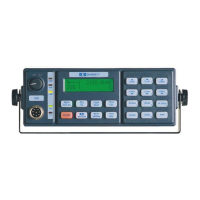
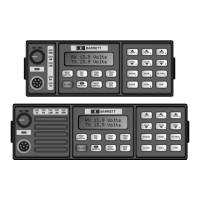
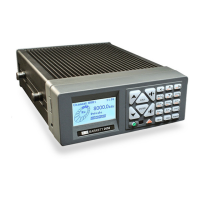
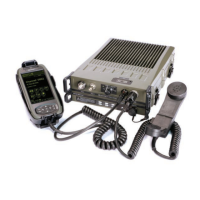
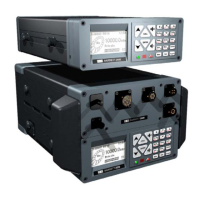
BARRETT 900 SERIES TRANSCEIVERS
4.2.2.1 Audio path
receive
transmit
In the demodulated Rx audio signal at a level of 50 mV P-P is fed into amplifier U22:B which raises
this level by 5dB. This signal is then split and fed to the main signal path and to the microprocessor PCB via
U22:A, where it is used in the mute and selcall system. Bilateral switch U14:C performs Tx/Rx changeover
for the main audio path and the signal then follows a common path through scrambler jumper J1, voltage
follower, U17:A, and 3kHz LPF U17:B. Bilateral switch U21:A is the mute gate which couples the received
audio to the voltage controlled amplifier (the volume control IC) IC's U28 and U32 via buffer U24:B. U27:B is
used to disable the audio to the 600 balanced audio output port during transmit i.e. when PTT PA is active.
U27:A and U27:C direct the transmit audio TX AUD to the 600 balanced audio output when SW1 is active.
This is for use when remote control functions are required.
The voltage controlled amplifiers IC's U28 and U32 are controlled by voltages from the volume
potentiometers from the remote head (when fitted) and the front panel (when fitted), respectively. The
receive audio signals from the volume control IC's are then combined with audio beeps and alarms (AUD
ALARM) from the Microprocessor PCB and fed to the speaker clamps Q22 and Q23 repectivley, which
suppress the audio on transmit. The power amplifier U23 raises both the audio signals to 2 W maximum in
order to drive the loudspeaker in either the remote head or front panel (which ever or both of which may be
fitted). Auxiliary muted Rx audio is available via balanced output amplifier U19 delivering 0dBm into 600 .
In a balanced op-amp U15:B provides 20 dB of mic gain for the local microphone. When the
auxilairy input is in use the auxiliary balanced amplifier U15:A receives signals at 0 dBm (600 ) input. When
the remote head microphone is in use the high level single ended mic audio from the remote head is
buffered by U24:A. The selected Tx audio signal in use at the time passes through the bilateral switches
U11:B, U16:A or U16:B to the Tx audio compressor circuit consisting of U18:B, Q27 and U18:A which
maintains a constant audio output over a large input range. Q27 acts as a variable resistor, controlled by
the output of the rectifier U18:B and D22. C107 is the timing capacitor. R217 controls attack time, and R141
controls release time. Transmit audio temperature compensation is provided by the network consisting of
TH1, R219 and R221. On transmit the signal is routed through the bilateral switch U14:C and on through
the common path of J1 and LPF. Jumper J1 is an ideal point to measure both transmit and receive audio.
The signal then passes directly to the IF section where it is used to modulate the exciter.
PAGE 22



 To Next Page