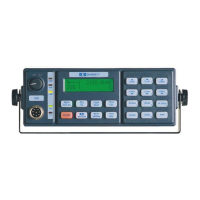
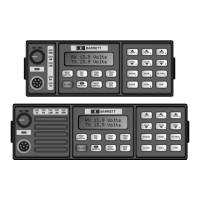
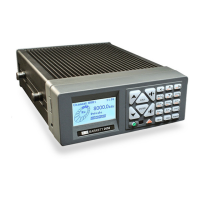
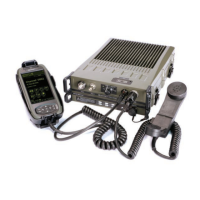
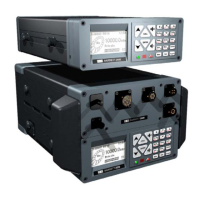
BARRETT 900 SERIES TRANSCEIVERS
The switch mode power supply is of a standard design. The FET Q1, when switched on, pulls current
through an inductor L2 to ground. When Q1 is switched off, this current then flows through the diode D3 and
powers the output. The output voltage is higher than the input but to maintain continuity in the current
through L2 the voltage must increase. Thus the voltage increase at the output of D3, when related to the
input of L2, is defined by the duty cycle of Q1. This duty cycle is controlled by the switch mode controller U1.
The input and output of this circuit are filtered to eliminate EMI.
The BCA94010 multiple-use distribution unit provides simultaneous access for a CW key, headphones,
13.8V power input and programming function for the 940 transceiver.
The Barrett 940 MkII Tuner is designed to interface the 940 portable transceiver to either a vertical whip
or a long wire antenna. The tuner requires only a power input, a RF feed and a tune line which when
pulled to ground will initiate a tune command.
The whip antenna is resonant at approximately 23MHz. Below resonance the whip presents a
capacitive reactance which needs to be tuned out with inductance. A binary network of inductors from
0.33µH to 84µH are used to give a total of 168µH. This is required for tuning at the lowest frequency.
When the whip is operated above resonance or there is a long wire connected a series capacitor (C1)
and two shunt capacitors (C10 & C11) are used to present a capacitive load. Any residual capacitance
is then removed by the inductive network.
To minimise the current draw of the unit all relays are latching. Low voltage relays are used to switch the
smaller coils whilst the larger value coils which produce the larger voltages (>500V) have the higher
spec G2R relays to switch them out of circuit. To minimise the contact voltages the largest inductor is
split into two smaller inductances of 42µH(L9 and L10). After a tune is performed the power supply to
the latching relays is removed. This increases the RF impedance to earth which minimises the chances
of a flash over from contact to coil.
A -10dB pad is switched in during the tuning procedure by RL12. The pad has the function of reducing
the RF voltage to minimise arcing and to present a resistive load to the transmitter so that it can provide
a full 20W during tuning. Whenever the pad is used a phase detector is also switched in. This
comprises of a current sense transformer (T3) and a voltage sense capacitor (C33). These two signals
are mixed and rectified via a diode network and generate a DC voltage whose polarity directly relates to
either leading or lagging load. The signal is converted to TTL by comparator U8 and is sent to the micro.
The usefulness of the phase detector is limited to below quarter wavelength resonance so for tuning
above this a 10:1 current transformer (T1) is employed. The current sensor measures the RF current
flowing into the tuning network. The maximum current into this network should directly correspond to the
minimum transmitter VSWR. The output of the current transformer is rectified and is sampled by the
microprocessor.
Once any whip or long wire reactance has been cancelled the impedance transformer is used find the
best VSWR. Two relays (RL15 and RL16) and a tapped inductor (T2) are used to give three different
impedance transforms (1:2, 1:1 and 2:1). This covers an impedance range of 12.5 to 200 . The
appropriate transform ratio is chosen depending on which delivers the most current through the current
sense network.
A PIC16C73 microprocessor is responsible for controlling all operations of the tuner. A pair of shift
registers (U4 and U5) are used to expand the external relays the micro can drive. The micro addresses
the relays in a serial fashion.
To reduce current consumption the microprocessor will put the tuner into scan mode and go to sleep
after a period of two minutes. Any burst of RF will wake the micro up again so that it may come out of
scan mode or may tune again. The microprocessor can directly measure the frequency of the input RF
via a diode network (D3-D5) and a capacitor sense (C13). If the frequency is the same then the
previous tune condition is restored. If the frequency is different then another tune will be attempted.
9.4.1.3 940 multiple-use distribution unit Barrett P/N BCA94010
9.4.1.4 940 automatic antenna tuner
Introduction
Tuning Network
Pad and Phase Detector
Current Sense
Impedance transformer
Microprocessor
PAGE 51



 To Next Page